How to Choose a Cleanser for Hard Water Skin
Tight, dull, or squeaky skin after washing can look identical on the surface, yet the cause behind it may differ, and so does the cleanser that suits it. Anyone working out how to choose a cleanser for hard water is really sorting through three possibilities: mineral residue, product buildup, or a skin barrier that is already irritated. Matching the cleanser to the likely cause tends to matter more than buying whatever is labeled "for hard water."
Hard water simply means water carrying a higher level of dissolved minerals, mainly calcium and magnesium. According to the U.S. Geological Survey, hardness varies widely by region, and it is a common feature of tap water in many parts of the United States. Those minerals can react with some cleansing agents and leave a film, which is why a cleanser that behaves well in one city may feel different in another. Individual skin responses vary, so the guidance below is a way to narrow things down, not a diagnosis.
Sorting Out What Is Behind Your Skin Complaints
Before comparing products, it helps to separate the usual suspects. Hard water gets blamed for a lot, but dryness, flaking, and breakouts have many everyday causes, including weather, over-exfoliating, and fragrance sensitivity.
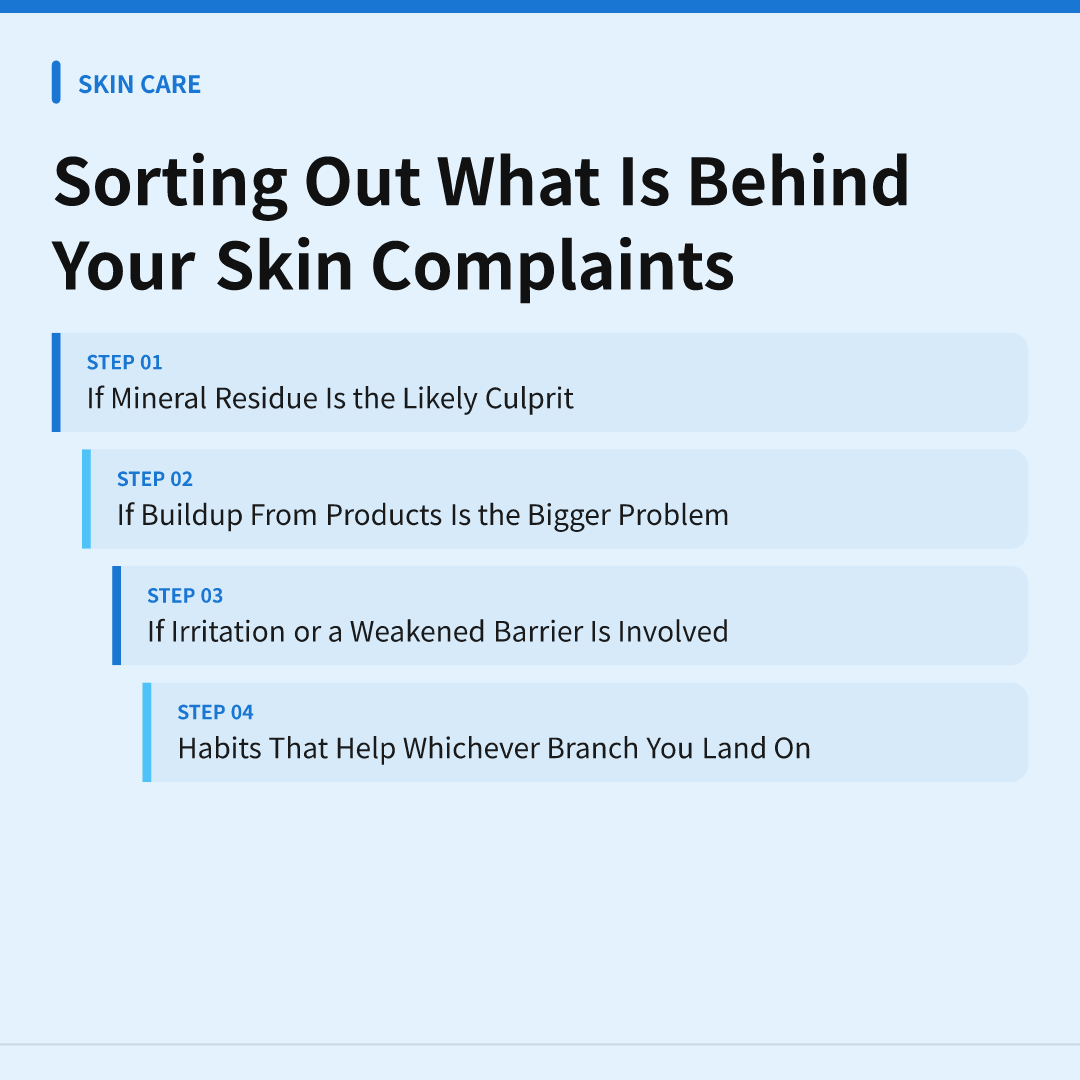
Three broad branches cover most situations people describe:
- Mineral or soap-scum residue: a faint film or "squeaky" feel that appears mainly when you wash with tap water.
- Cleanser or product buildup: dullness or clogged-feeling skin that has more to do with what stays on the face than with the water itself.
- A stressed skin barrier: stinging, redness, or tightness that happens with many products, in many places.
A simple comparison can point toward the right branch. If symptoms eased when you traveled to a place with softer water, the water may be playing a role. If they follow you everywhere and flare with new products, barrier irritation is more likely. Mixed pictures are common, and that is fine; most people sit somewhere between two branches.
Guessing wrong has a cost. Someone with an irritated barrier who buys a strong chelating or clarifying cleanser may end up more irritated. Someone with true residue who keeps adding richer moisturizers may just add more layers on top of the film. That wasted time and money is the reason to sort first, then shop.
If Mineral Residue Is the Likely Culprit
How to tell whether this fits
Residue-type problems often show up as a slightly rough or filmy feel after rinsing, a tight sensation that appears quickly, or a cleanser that seems to foam less than it should. Some people also notice a chalky look on dark clothing or a cloudy film on shower glass and faucets, which at least confirms the water is mineral-rich. Skin-wise, though, none of these signs is conclusive on its own.
A quiet clue is timing. If your skin feels fine right after cleansing with bottled or filtered water but feels different with tap water, minerals are a reasonable suspect. This is an informal observation, not a test, and plenty of other factors can overlap.
What to look for in a cleanser
Traditional bar soaps are made with a process that can react with calcium and magnesium, and that reaction is what forms scum. Many liquid and gel cleansers use synthetic surfactants that are generally described as less prone to that reaction, which is why they are a common starting point for people in hard water areas. Look at the ingredient list rather than the front label, since "gentle" and "soap-free" are marketing terms with no single fixed meaning.
- Synthetic surfactant-based formulas: often described as milder with mineral-rich water than traditional soap bars.
- Chelating ingredients: some cleansers include ingredients such as EDTA or similar compounds that bind minerals. Others use gluconate-type ingredients for a similar purpose. These can be useful, but sensitivity to them varies.
- Mild, low-fragrance formulas: fewer additives means fewer variables if your skin is reactive.
- Balanced, not harshly alkaline, feel: products that leave skin feeling stripped are worth reconsidering.
Worth knowing: chelating cleansers are not automatically better. Some people with sensitive or compromised skin find them drying, and a stronger approach can backfire if the real issue is barrier irritation. Start with a gentle option and adjust gradually rather than jumping to the most aggressive-sounding product.
Related reading: Skincare Routine for Sensitive Skin: Build It Around Habits You Already Have
If Buildup From Products Is the Bigger Problem

How to tell whether this fits
Buildup tends to look like dull, congested, or uneven skin, makeup or sunscreen that seems to cling, or a cleanser that never quite feels like it finishes the job. It can happen in soft water areas too, so if your skin did not change much when you moved or traveled, buildup deserves a closer look. Heavy sunscreens, long-wear makeup, and rich balms are the usual contributors, according to general consumer skin-care guidance from the American Academy of Dermatology.
Hard water can make this trickier, because minerals may reduce how well some cleansers lather and rinse. If the cleanser does not lift products cleanly, the result may be a layered, slightly tacky feel that gets blamed on the water when the routine is also part of the picture.
What to look for in a cleanser
When the main issue is removing products, the cleanser's cleansing method matters as much as its tolerance for minerals. Many people use a two-step approach in the evening, and the choice depends on what is being removed.
- Oil or balm cleansers: often used to dissolve sunscreen and makeup, then followed by a gentle water-based cleanser. They rely on oils rather than lather, which can make them less dependent on water hardness, though they still need to rinse off cleanly.
- Micellar waters: a no-rinse-style option some people use to lift makeup. Some formulas leave residue, so check how your skin feels afterward.
- Gentle gel or cream cleansers: a common second step once heavy products are gone.
The trade-off is that adding steps adds more chances for irritation. If your skin is reactive, a simpler routine may be better than a layered one. Product instructions on each item and guidance from a licensed professional can help you decide how much cleansing your skin actually needs.
If Irritation or a Weakened Barrier Is Involved
How to tell whether this fits
Stinging, visible redness, rough patches, or a feeling that many products suddenly "sting" can point toward a skin barrier that is under strain. Hard water may add to that strain for some people, but so can over-cleansing, strong actives, scrubs, and dry weather. The American Academy of Dermatology notes in its general guidance that skin that is already dry or sensitive tends to react more readily to harsh cleansing.
One practical sign is that gentler habits help more than a change in cleanser type. If pausing exfoliants and strong actives brings noticeable calm, the barrier may have been the main issue rather than the water.
What to look for in a cleanser
For irritated skin, the goal shifts from "removing minerals" to "not making things worse." Mild, fragrance-free, non-stripping formulas are the usual direction, and a chelating cleanser may or may not be a fit depending on how reactive you are.
- Fragrance-free and low-ingredient formulas: fewer potential irritants to sort through.
- Creamy or lotion-style cleansers: often described as less drying than foaming gels for some skin types.
- Patch testing: trying a new product on a small area first is a widely mentioned precaution, since reactions vary from person to person.
Skin that stays red, painful, swollen, or oozing, or that has persistent rashes, is a reason to talk with a dermatologist or other licensed clinician rather than keep experimenting with cleansers. Conditions such as eczema, rosacea, and contact dermatitis can look like simple "dry skin" at first, and a cleanser alone is not meant to address them.
Related reading: What Ceramides Do for Skin and the Barrier
Habits That Help Whichever Branch You Land On
Some steps are useful no matter the cause, and they cost little. None of them is a guarantee, but they tend to reduce the variables.
- Rinse thoroughly: leftover cleanser is a common contributor to a filmy feel, and hard water can make rinsing less satisfying than it seems.
- Mind the water temperature: very hot water is often described as drying, so lukewarm is a frequent suggestion.
- Pat dry gently: rubbing with a towel can add friction to already tired skin.
- Moisturize while skin is still slightly damp: many people find this helps skin feel more comfortable, though preferences differ.
- Change one thing at a time: if you swap three products at once, you will not know which one made the difference.
Water-side options exist too. Shower filters and whole-home softeners are sometimes mentioned as ways to change the water itself, but how much they affect skin varies, and claims on product packaging are not always backed by independent evidence. The Environmental Protection Agency's general consumer information on drinking water treatment is a useful place to understand what these devices are designed to do, and a quick look at your local water utility's report can tell you how hard your water actually is.
If you are curious about your own situation, a simple home water hardness test strip is inexpensive, and your water provider may publish hardness levels for your area. Knowing the baseline makes it easier to judge whether hard water is a plausible factor or a convenient scapegoat.
Related reading: A Simple Skincare Routine for Dry Skin: Start Small
Putting It All Together
Choosing a cleanser for hard water comes down to matching the product to the likely cause. If mineral residue seems to be the main issue, many people start with a mild synthetic-surfactant cleanser and consider a chelating formula only if their skin tolerates it. If product buildup is the bigger factor, an oil-based or balm-style first step followed by a gentle second cleanse is a common approach. If irritation or a strained barrier is involved, simpler, fragrance-free, non-stripping options tend to be the safer direction, and fewer steps often beat more.
When the picture is unclear, there are sensible ways forward. You can change one variable at a time over several weeks, check your local water hardness information, or try a basic routine for a while before adding anything new. If symptoms persist, worsen, or look like a rash or inflammatory skin condition, a dermatologist or other licensed professional can help sort out what is happening and what is appropriate for your skin. Results vary, and patience usually serves better than a dramatic overhaul.
Disclaimer: This article is for informational purposes only and is not a substitute for professional medical advice, diagnosis, or treatment. Please consult a licensed professional for personal health decisions.