A Simple Skincare Routine for Dry Skin: Start Small
A skincare routine for dry skin does not need ten steps, and for most people two habits matter more than everything else: gentle cleansing and consistent moisturizing. Everything beyond that is optional, and some of it may even work against you. This guide ranks what to prioritize, what to add when you have the energy, and what you can safely let go of.
Here is a pattern that shows up again and again. Someone with tight, flaky skin reads about layering serums, essences, oils, masks, and exfoliants, buys a small shelf's worth of products, and tries to do all of it every night. After a week or two it feels like a chore, the skin looks irritated rather than calmer, and the whole thing gets abandoned. A smaller routine you actually keep is usually more useful than an ambitious one you drop.
A quick note on perspective: I am a beauty and lifestyle writer, not a dermatologist or esthetician. What follows is general information drawn from commonly shared skincare principles, not personal medical advice. Dry skin varies a lot from person to person, so treat this as a starting framework rather than a prescription.
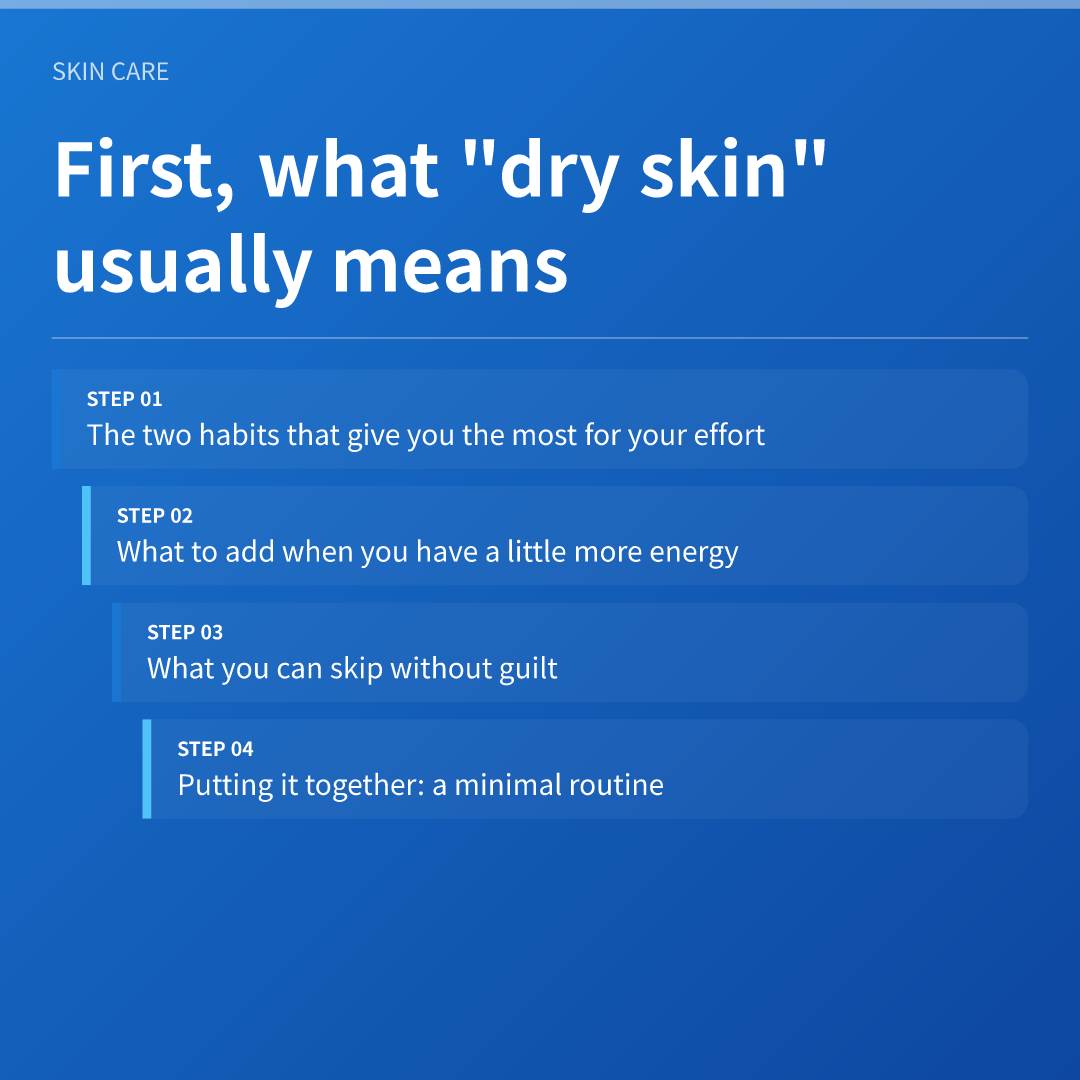
First, what "dry skin" usually means
Dry skin generally describes skin that has trouble holding onto water and the oils that help keep its outer layer comfortable. It can feel tight after washing, look dull or rough, and sometimes flake or itch. According to the American Academy of Dermatology's general guidance, dry skin is common and often linked to factors like weather, indoor heating, hot water, and harsh cleansing products.
It helps to separate two ideas that often get blurred. Dry skin is a skin type or a tendency, while dehydrated skin refers to a temporary lack of water that can affect any skin type. The practical difference is that the same basic habits tend to help both, but persistent or severe dryness may point to something else entirely, which we will come back to near the end.
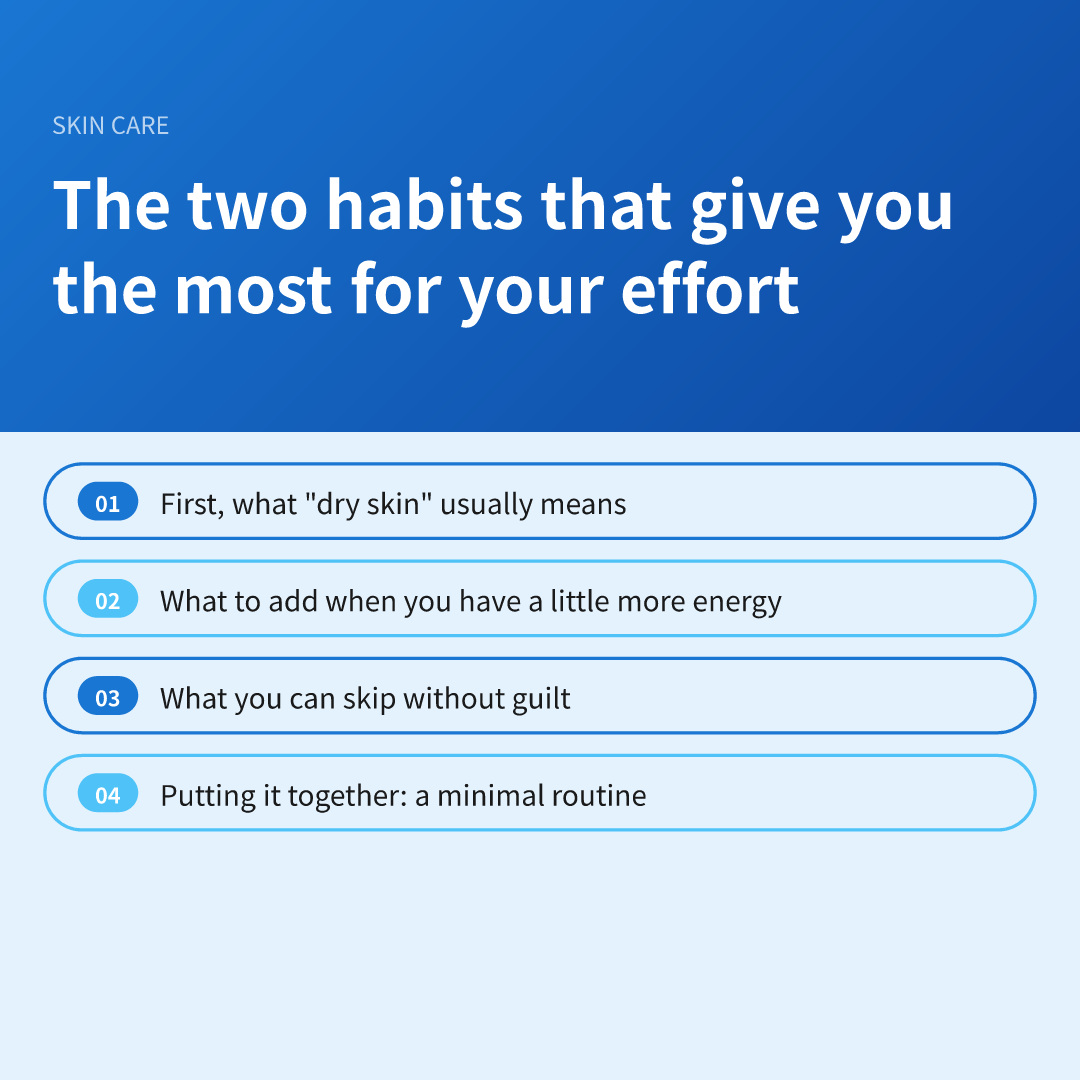
The two habits that give you the most for your effort
1. Cleanse gently, and keep it brief
If you only change one thing, consider what touches your face and body in the shower or at the sink. Foaming, strongly scented, or very "squeaky clean" cleansers can strip away oils that dry skin already struggles to hold. Many people with dry skin find that a mild, fragrance-free, creamy or lotion-style cleanser feels more comfortable than a foaming one.
Water temperature matters too. Very hot water is commonly described as drying, so lukewarm tends to be the gentler choice. Long showers and scrubbing with rough washcloths can add to the problem. The American Academy of Dermatology's general advice for dry skin points in this same direction: gentler products, shorter time in water, and patting rather than rubbing dry.
The limit here is worth stating honestly. Switching to a gentler cleanser will not repair underlying skin conditions, and it will not change how your skin behaves overnight. It simply removes one common source of extra dryness, which is often a good place to start.
2. Moisturize consistently, especially after washing
The second high-value habit is a moisturizer you will actually use. Dermatology organizations commonly note that moisturizers work best when applied to skin that is still slightly damp, because they can help seal in water that is already there. That small timing detail costs nothing and is often more useful than adding another product.
When shopping, you will see a few ingredient families repeated in moisturizers aimed at dry skin. Humectants such as glycerin and hyaluronic acid attract water. Emollients such as ceramides and fatty acids help smooth and soften the surface. Occlusives such as petrolatum and certain butters sit on top to reduce water loss. Many well-formulated creams combine these, and no single ingredient is the "right" one for everyone.
Texture is a personal choice. Thicker creams and ointments tend to feel richer, while lotions spread more easily but are generally lighter. If a product stings, burns, or leaves your skin red, that is a sign it may not suit you, and it is reasonable to stop and ask a pharmacist or dermatologist what might be a better fit. Reactions vary from person to person, and "gentle" on a label is not a guarantee.
What to add when you have a little more energy
Once cleansing and moisturizing feel automatic, you can consider a few extras. None of them are required, and it is perfectly fine to stay with the basics indefinitely. If you add anything, adding one thing at a time makes it much easier to tell what your skin likes and what it does not.
Daily sunscreen
Sun protection is probably the most widely recommended extra. The U.S. Food and Drug Administration and the American Academy of Dermatology both emphasize sunscreen as part of everyday sun protection. For dry skin, some people prefer a moisturizing or cream-style formula, and some find that mineral-based options feel gentler, though preferences differ. Product directions on the label explain how to use it, and a dermatologist can help if you are unsure which type suits sensitive skin.
A hydrating serum or essence
Lightweight products with humectants like glycerin or hyaluronic acid are popular with people who want an extra layer of hydration. Their effect is generally temporary and surface-level, and they usually work best when followed by a moisturizer rather than used instead of one. If your skin already feels comfortable with a good cream, a serum may simply be a nice extra rather than a necessity.
A barrier-supporting cream or ointment for problem spots
Areas like hands, elbows, lips, and shins often get drier than the rest of the body. Many people keep a richer, simple product on hand for those spots. If a particular area is cracked, bleeding, or very itchy, that is worth mentioning to a healthcare professional rather than managing with cosmetics alone.
A humidifier or small environmental changes
Dry indoor air can make skin feel worse, especially in colder months when heating is on. Some people find that a humidifier makes their space more comfortable. The evidence for its effect on skin specifically is limited, so think of it as a comfort measure that may or may not make a noticeable difference for you. If you use one, cleaning it according to the manufacturer's instructions matters.
Related reading: How to Exfoliate Gently Without Irritating Your Skin
What you can skip without guilt

This section is here to lighten the load. Social media often makes a routine feel inadequate unless it includes a dozen steps. For dry skin, many of those steps are optional at best and irritating at worst.
- Frequent harsh exfoliation. Scrubs, strong acids, and rough tools can be too much for skin that is already struggling to hold moisture. Some people with dry skin tolerate mild exfoliation occasionally, but it is not a required step, and overdoing it is a common cause of irritation.
- Strongly fragranced products. Fragrance and essential oils are common irritants for sensitive or dry skin. A pleasant scent is not a benefit your skin needs.
- Alcohol-heavy toners. Products with a strong drying feel may leave dry skin tighter. A toner is not a required step in any routine.
- A different product for every concern. More products means more chances for irritation and more difficulty identifying the cause when something goes wrong.
- Constant product switching. Changing creams every week makes it hard to tell what is helping. Skin generally responds gradually, so patience is part of the process.
- Chasing "glass skin" or other trends. Photos online are often filtered, lit, or styled. Your goal can simply be skin that feels comfortable.
Skipping these steps is not laziness. It is often just a more realistic approach, especially when your skin is already easily irritated.
Putting it together: a minimal routine
In plain terms, a stripped-down version looks like this. In the morning, rinse or cleanse gently if needed, use a moisturizer, and add sunscreen if you are heading outdoors. In the evening, cleanse gently and moisturize while your skin is still slightly damp. That is the whole structure. Everything else in this article is an optional layer on top.
If even that feels like too much on a given day, a rinse and a moisturizer is still better than nothing. A routine that bends on busy days is more likely to last than one that demands perfection.
When dry skin deserves a professional look
Basic habits are reasonable for ordinary dryness, but they have limits. Persistent redness, intense itching, cracking, oozing, a rash that spreads, or dryness that does not improve with gentle care may be signs of a condition such as eczema, contact dermatitis, or something else. The National Institutes of Health and other public health sources note that several skin conditions can look similar to simple dryness at first glance, which is why a proper evaluation matters.
Dryness can also be influenced by certain medications, health conditions, and age. If your skin changed suddenly, or if over-the-counter care is not helping, it makes sense to speak with a doctor or dermatologist. For any prescription or medicated product, a pharmacist or clinician can explain how it should be used, and this article cannot do that for you.
Frequently asked questions
Can I use the same moisturizer on my face and body?
Sometimes, but not always. Facial skin is often more reactive, and body products may contain ingredients or fragrances that feel too heavy or irritating on the face. If you want to simplify, try a fragrance-free product and pay attention to how your skin responds, or ask a pharmacist for suggestions.
Do I need to wash my face in the morning if my skin is dry?
Not necessarily. Some people with dry skin choose to rinse with water in the morning and save cleanser for the evening, especially if they cleansed the night before. This is a personal preference, and what feels comfortable on your skin is a reasonable guide.
Is a thicker cream always better for dry skin?
Not always. Richer products can feel soothing, but some people find them heavy or find that they clog pores or cause breakouts. The better choice is generally the one your skin tolerates and that you will use consistently, and that can differ by season, climate, and body area.
Why do some people notice changes sooner than others?
Skin responds differently depending on what is causing the dryness in the first place. Weather, water habits, age, underlying skin conditions, the products you used before, and how consistently you follow a routine all play a part. Some people feel more comfortable fairly quickly after a gentler routine, while others notice a slower shift, and some need professional input before things improve. That variation is normal, which is why comparing your progress to anyone else's, or to a promised timeline, is rarely helpful. A steady, simple skincare routine for dry skin gives your skin a fair chance, and a professional can help if comfort does not come.
Disclaimer: This article is for informational purposes only and is not a substitute for professional medical advice, diagnosis, or treatment. Please consult a licensed professional for personal health decisions.