What Does Niacinamide Do for Your Skin?
Niacinamide is a form of vitamin B3 that skincare brands add to serums, moisturizers, and toners, and what niacinamide does in a product is mainly support the skin's barrier and help skin look more even and balanced over time. It is a water-soluble ingredient (meaning it dissolves in water rather than oil) that skin cells use in their normal everyday chemistry. Below, you will learn what the ingredient actually is, when it tends to be useful, how it differs from ingredients people often mix it up with, and why that matters for your routine.
The Exact Meaning of Niacinamide in Skincare

Niacinamide is also called nicotinamide. Both names describe the same vitamin B3 compound, so a label that lists either one is pointing to the same ingredient. It is not the same thing as niacin, a related form of vitamin B3 that is known for causing flushing when taken in certain ways, which is one reason the two names are worth keeping straight.
Think of your skin's outer layer like a brick wall, with skin cells as the bricks and natural oils as the mortar between them. Niacinamide is often described as an ingredient that supports that mortar, helping the wall hold in moisture and keep out irritants. That is the one picture worth holding onto, because most of what the ingredient is known for connects back to barrier support.
Where it comes from
Your body gets vitamin B3 from food, and the National Institutes of Health Office of Dietary Supplements describes it as a nutrient involved in how the body turns food into energy. In skincare, a lab-made version of the same compound is used in formulas. Eating foods with vitamin B3 and putting niacinamide on your skin are two different things, and one does not stand in for the other.
Why formulas include it
Brands tend to like niacinamide because it dissolves easily, pairs with many other ingredients, and is generally tolerated by many skin types. It shows up in everything from lightweight gel serums to rich night creams. Because it is so widely used, you may already own a product that contains it without having noticed.
Situations Where Niacinamide Is Commonly Used

Niacinamide is often chosen for cosmetic goals rather than medical ones. Some people reach for it when their skin looks uneven in tone, feels rough, or seems to lose moisture quickly. Others pick it because their pores look more noticeable, or because their skin looks shiny by midday. Results vary from person to person, and changes usually show up gradually rather than quickly.
Barrier support and dryness
When the skin barrier is not working at its best, skin can feel tight, dry, or easily bothered. Niacinamide is commonly described as an ingredient that may help support the barrier so skin holds onto water better. Pairing it with a plain moisturizer is a common approach in general skincare discussions.
Uneven tone and dull-looking skin
Some people use niacinamide because they want skin to look more even, including the look of marks left after a blemish has faded. The American Academy of Dermatology Association has published general skin care information that mentions niacinamide among ingredients people may encounter in products aimed at tone and texture. What this means in practice is that it may help skin look a bit smoother over weeks, not that it removes marks outright.
Oily or breakout-prone skin
People with oily skin often find niacinamide-containing products feel light and non-greasy. Some people use it as one part of a routine for skin that gets congested. It is not a replacement for care from a professional if breakouts are painful, widespread, or leaving scars.
Related reading: How to Build a Simple Skincare Routine That Sticks
Where it fits poorly
Niacinamide is not designed to treat a skin condition. If you have a rash, persistent redness, or a patch that looks different from the rest of your skin, a cosmetic ingredient is not the right first step. A licensed clinician can look at what is going on and tell you what makes sense.
Niacinamide Versus the Ingredients People Confuse It With
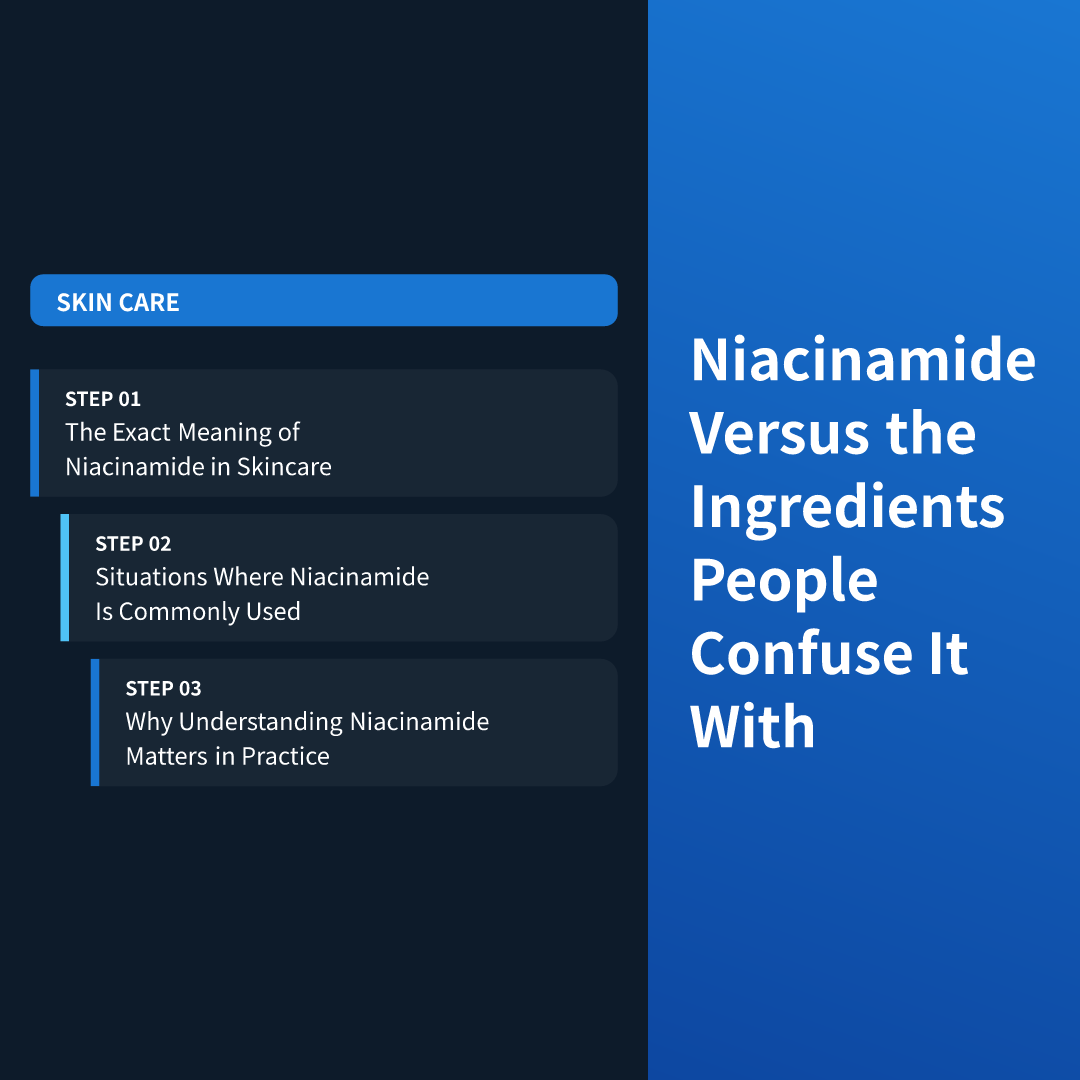
Because skincare labels are crowded with similar-sounding names, mix-ups are common. Sorting them out helps you read ingredient lists with more confidence.
Niacinamide and niacin
These are both forms of vitamin B3, but they behave differently. Niacin is the form associated with flushing, while niacinamide is the form used in most skincare products. If a product lists "niacinamide" or "nicotinamide," you are looking at the skincare version.
Niacinamide and vitamin C
You will often hear that these two cannot be used together. That idea has been repeated for years, but many modern formulas combine them, and plenty of people use both without trouble. Still, skin can react differently to different pairings, so if your skin gets irritated, it is reasonable to simplify the routine and talk to a professional.
Niacinamide and retinoids
Retinoids are vitamin A derivatives (a family of ingredients related to vitamin A) that are known for being more irritating at first. Niacinamide is a different type of ingredient and is often described as gentler. Some people pair them, and some find the combination fine, but how to combine prescription retinoids with other products is a question for the prescriber or a pharmacist.
Niacinamide and exfoliating acids
Exfoliating acids such as glycolic or salicylic acid work by loosening dead skin cells on the surface. Niacinamide does not exfoliate; it works in a different way. Layering several active products at once raises the chance of stinging or redness, so many people introduce one new product at a time.
Related reading: How to Layer Moisturizer and Sunscreen Without Pilling
Why Understanding Niacinamide Matters in Practice

Knowing what niacinamide is, and what it is not, keeps expectations realistic. It is a supporting ingredient, not a fast fix, and it works best as part of a steady routine with a gentle cleanser, moisturizer, and daily sun protection. The U.S. Food and Drug Administration notes that cosmetics are not meant to treat or cure disease, which is a useful reminder when a label sounds more dramatic than the ingredient deserves.
Possible reactions and limits
Reactions vary from person to person. Some people notice stinging, redness, itching, or a warm feeling, especially if their skin is already sensitive or the product has a lot of other ingredients. Fragrance, alcohol, and strong acids in the same formula can sometimes be the real cause rather than niacinamide itself.
- People with very sensitive skin, eczema, or rosacea may want to ask a clinician before trying a new active product.
- Anyone with a known allergy to a product ingredient should read the full label first.
- Pregnant or nursing people with questions about skincare ingredients can ask their healthcare provider.
- Children's skin care questions are best taken to a pediatrician or dermatology professional.
The American Academy of Dermatology Association generally suggests testing a new product on a small area of skin before using it more widely, which is a sensible habit with any new product. Product directions on the label are the starting point, and a pharmacist or clinician can help if you are unsure.
When to see a professional
Seek care if you develop swelling, hives, blistering, or a spreading rash, or if breathing or swallowing feels difficult after using a product. Those signs call for prompt medical attention rather than waiting to see if skin settles. Ongoing acne, painful bumps, unexplained dark patches, or marks that are changing in shape or color should also be looked at by a licensed professional rather than managed with cosmetics alone.
Reading labels with more confidence
Concentration claims on packaging are not always easy to compare, and a higher number is not automatically better. A well-made product with a modest amount of niacinamide can suit one person, while another person's skin may prefer a simpler formula. It helps to look at the whole ingredient list rather than a single headline ingredient.
Two Decisions That Become Easier Once You Know What Niacinamide Does
First, you can judge a product by what it realistically offers. Since niacinamide is mainly about supporting the barrier and the overall look of skin, you can treat it as a steady, long-term addition instead of expecting overnight change, and you can skip products that promise dramatic results from this one ingredient.
Second, you can decide when a cosmetic is not enough. If your concern involves pain, persistent redness, a spreading rash, or something that keeps coming back, the better next step is a conversation with a licensed professional, not a stronger serum. Understanding what niacinamide does, and where its role ends, makes that call a lot clearer.
Disclaimer: This article is for informational purposes only and is not a substitute for professional medical advice, diagnosis, or treatment. Please consult a licensed professional for personal health decisions.