How to Build a Simple Skincare Routine That Sticks
The easiest way to learn how to build a simple skincare routine is to stop treating it as a brand-new task and instead attach it to something you already do every day. Brushing your teeth, making coffee, or plugging in your phone at night are all moments your brain already remembers without effort. If you tie a skincare step to one of those existing habits, you skip the hardest part of any routine — remembering to start it in the first place.
This approach is sometimes called habit stacking, and it works well for skincare because most people don't fail at routines from lack of knowledge. They fail because the steps live in a vacuum, disconnected from the rest of the day. Below is a practical way to find your anchor habits, attach the right skincare actions to them, and recover quickly when life gets in the way — because it will, and that's normal.
Finding an Existing Habit to Anchor Your Routine To
Before adding any product, take a mental inventory of things you already do without needing a reminder. These are your anchor habits, and they don't have to be related to beauty or hygiene at all. The goal is consistency, not theme.
- Brushing your teeth in the morning and at night
- Making your morning coffee or tea
- Changing out of your day clothes
- Charging your phone before bed
- Washing your face after a workout (if that's already routine for you)
Pick one anchor for morning and one for night. It helps to choose habits that already happen near a bathroom or bedroom, since that's usually where skincare products live. If your anchor habit happens somewhere inconvenient, like your kitchen, you may need to keep a small travel-size product nearby so the new step doesn't require extra effort or a detour.
Why the Location of the Habit Matters
A habit stack tends to break down when the new action requires walking to another room. If your toothbrush is in the bathroom but your moisturizer is in your bedroom, that gap is often enough to skip the step on a tired night. Keeping products physically close to the anchor habit removes friction, which matters more than motivation when you're building something long-term.
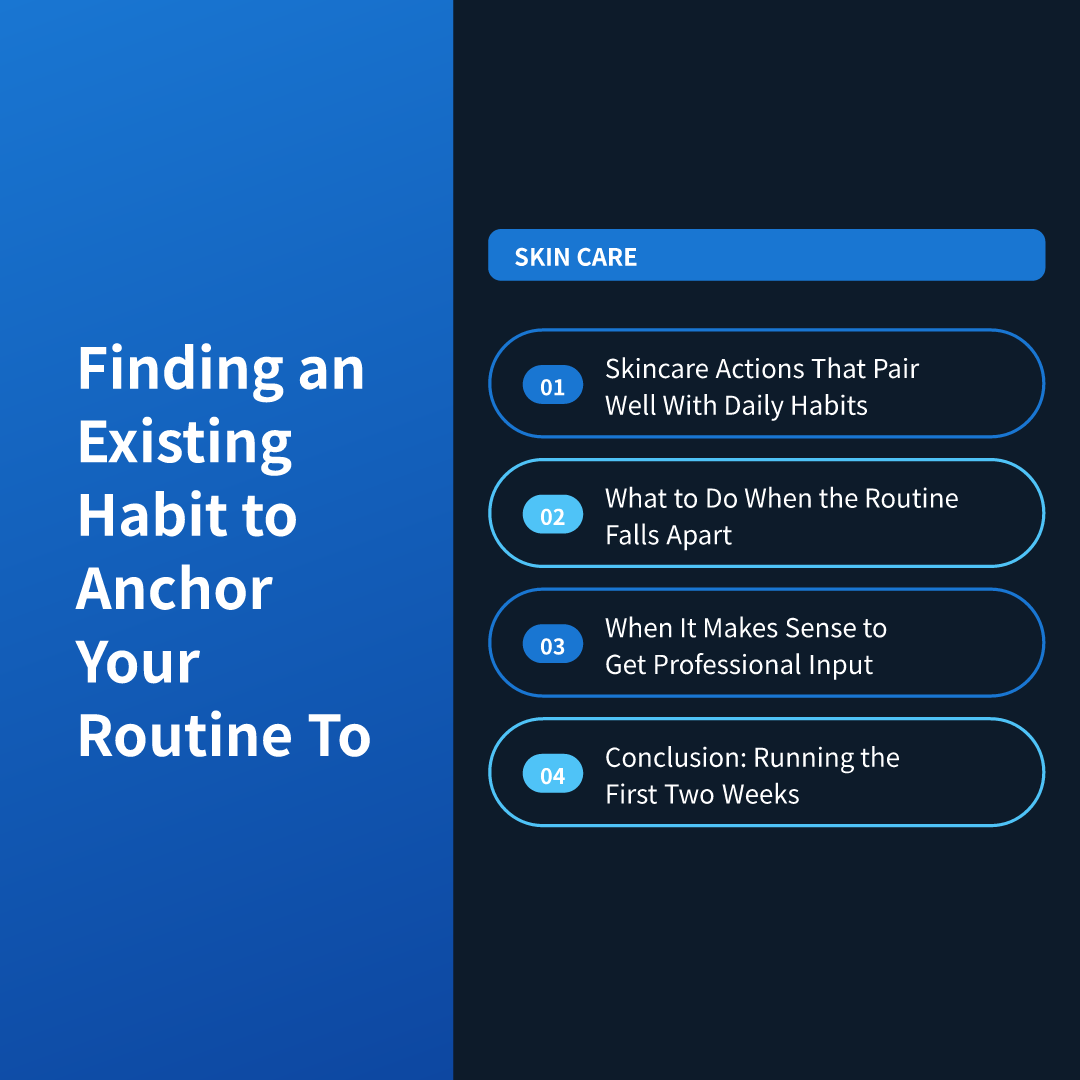
Skincare Actions That Pair Well With Daily Habits
Once you have your anchor habits, the next step is matching them with a simple skincare action. A basic routine generally includes cleansing, moisturizing, and sun protection during the day, with the option to add a treatment step at night. You don't need every product on day one — start with one pairing and add more once it feels automatic.
Morning Pairings
- Anchor: Brewing coffee → New step: Cleanse your face while the coffee brews, then apply moisturizer and sunscreen before you sit down to drink it.
- Anchor: Brushing your teeth → New step: Apply sunscreen right after you rinse, since your hands are already near your face.
- Anchor: Getting dressed for the day → New step: Apply moisturizer right before you put on your shirt, so damp skin isn't a reason to skip it.
Night Pairings
- Anchor: Changing into pajamas → New step: Cleanse your face right before you change clothes.
- Anchor: Charging your phone → New step: Apply your night moisturizer or treatment product right after you plug in your phone, since that's often the last thing people do before bed.
- Anchor: Brushing your teeth at night → New step: Follow it immediately with cleanser, since both happen at the sink.
According to general skincare guidance often shared by dermatology associations, a simple daily routine for most people includes a gentle cleanser, a moisturizer suited to their skin type, and daytime sun protection. Anything beyond that — like exfoliants, retinoids, or targeted treatments — is usually easier to introduce one at a time, ideally with input from a professional if you have sensitive or reactive skin.
People with oily or acne-prone skin sometimes want to add more steps quickly, but layering too many new products at once makes it hard to tell what's helping and what's causing irritation. People with dry or sensitive skin often do better focusing on a rich moisturizer and a fragrance-free cleanser before adding anything active. Skin type differences matter here, and a routine that works for one person may not suit another.
Adding a Weekly Step
Once your daily pairing feels automatic — usually after a couple of weeks — you can attach a weekly step to another habit, like laundry day or a weekend morning. A gentle exfoliant or a hydrating mask are common choices for a once-a-week addition, though how often any active ingredient is used really depends on the product itself and your skin's tolerance. If you're unsure, checking the product's instructions or asking a pharmacist is a reasonable next move.
What to Do When the Routine Falls Apart
Almost everyone skips their skincare routine at some point — travel, illness, exhaustion, or simply a chaotic week can all break the chain. The mistake isn't missing a day; it's treating one missed day as proof that the whole system failed. A simple recovery rule helps more than trying to be perfect.
The "Next Anchor" Recovery Rule
If you miss a step, don't wait for tomorrow morning to restart. Instead, pick it back up at your very next anchor habit. If you forgot your night routine, the next time you brush your teeth in the morning is your restart point — not a reason to wait until evening again. This keeps the gap small and prevents one missed night from turning into a missed week.
A missed step is a pause, not a restart from zero. The routine only breaks down when you decide it has to be perfect to count.
Simplify Before You Quit
If you find yourself skipping the routine often, it may be a sign that it has too many steps for your current schedule, not that you lack discipline. In that case, drop back to the single most important step — usually cleansing or sunscreen — and rebuild from there once things settle. Reintroducing extra steps only after the core habit feels stable tends to work better than trying to restart everything at once.
It's also worth noting that skin can react to inconsistency, especially if you're using active ingredients like retinoids or exfoliating acids. Starting and stopping these products repeatedly may increase irritation risk for some people, so if you've paused for more than a week or two, easing back in slowly is generally a safer approach than resuming at full strength. If you notice ongoing redness, stinging, or breakouts that don't settle, that's a good signal to check in with a dermatologist rather than troubleshoot alone.
Related reading: Skincare Routine Basics for Oily Skin You Can Keep Up
When It Makes Sense to Get Professional Input
A habit-stacked routine works well for general maintenance, but it has limits. Persistent acne, unexplained rashes, sudden changes in your skin, or reactions that don't improve after removing a suspected product are all situations where a dermatologist's input is more useful than continuing to adjust things on your own. Over-the-counter routines are generally designed for maintenance and mild concerns, not for diagnosing or treating underlying skin conditions.
Conclusion: Running the First Two Weeks
Learning how to build a simple skincare routine really comes down to attaching small actions to habits you already trust yourself to do, and having a plan for the days it doesn't go perfectly. The goal in the beginning isn't a complete routine — it's a routine you'll still be doing in a month.
- Pick just one morning anchor and one night anchor for the first two weeks — resist adding more steps early on.
- If you miss a step, restart at your very next anchor habit instead of waiting for a new day.
- Keep products physically next to the anchor habit so the new step never requires an extra trip or extra effort.
Once these two weeks feel automatic, you can layer in additional steps one at a time, always paying attention to how your skin responds. A simple, sustainable skincare routine tends to outperform an elaborate one that's hard to keep up with, and giving yourself room to recover from missed days is part of what makes it last.
Disclaimer: This article is for informational purposes only and is not a substitute for professional medical advice, diagnosis, or treatment. Please consult a licensed professional for personal health decisions.