How to Exfoliate Gently Without Irritating Your Skin
Learning how to exfoliate gently starts with one idea: less friction, fewer harsh actives, and more attention to how your skin responds. Many people reach for a gritty scrub or a strong acid because they want smooth skin quickly, then end up with tightness, stinging, redness, or flaky patches. It is a common cycle, and it usually comes from doing too much, too often, or with products that are too strong for that person's skin. Fixing it is less about finding a magic product and more about getting the order right.
That order matters. First you work out what is actually happening on your skin, then you calm things down right away, then you rebuild a mild routine over the coming week, and finally you keep it steady over time. Below is a time-based way to think through each stage, along with the limits of cosmetic exfoliation and the signs that it is time to talk to a professional.
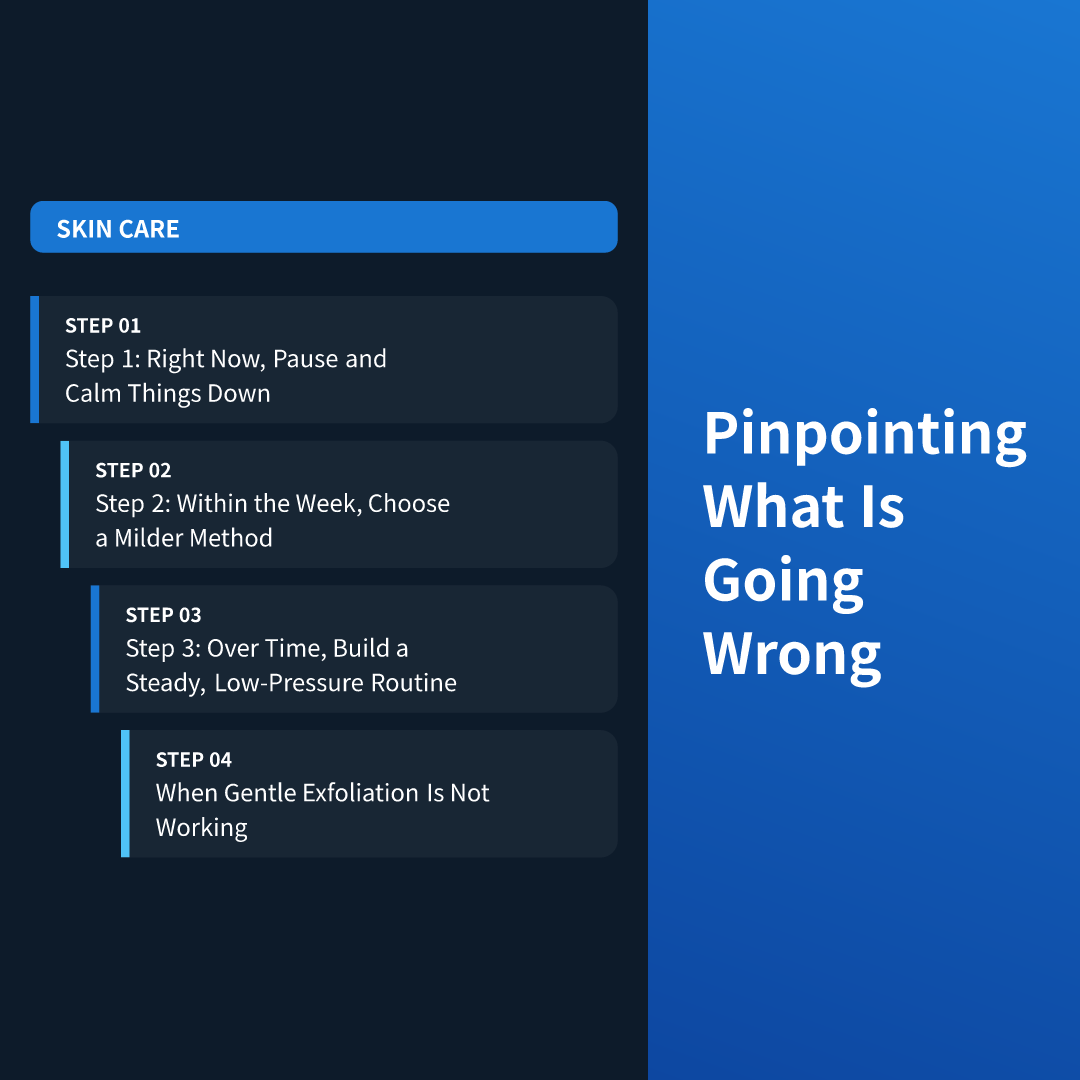
Pinpointing What Is Going Wrong
Before changing anything, it helps to figure out whether the problem is the exfoliation itself. Rough texture, dullness, and clogged-looking pores can push people to scrub harder, yet those same signs can also show up when the skin barrier is stressed. The two situations call for very different responses.
Signs your skin may be over-exfoliated
Common signs people describe include a tight or shiny look, stinging when applying ordinary moisturizer, persistent redness, rough or flaky patches, and new sensitivity to products that were previously fine. Breakouts can also appear when the skin is irritated. The American Academy of Dermatology (AAD) general guidance notes that harsh scrubbing and overly aggressive products can irritate skin, which is why a gentler approach is often suggested for sensitive or reactive types.
Why the method matters as much as the product
Exfoliation falls into two broad groups. Physical exfoliation uses friction, such as scrubs, brushes, or washcloths. Chemical exfoliation uses ingredients like alpha hydroxy acids, beta hydroxy acids, or polyhydroxy acids that loosen the bonds between surface cells. Neither group is automatically gentle or harsh. A coarse scrub pressed hard can be rough on skin, and a strong acid used too often can be too. A mild formula handled lightly can be a reasonable option for many people, though reactions vary from person to person.
Consider your skin type and situation
- Dry or sensitive skin: often more prone to stinging and flaking, so mild options and longer gaps between sessions are commonly preferred.
- Oily or combination skin: may tolerate more, but oily skin can still become irritated and compensate with extra shine.
- Skin with eczema, rosacea, or active inflammation: exfoliation can be a poor fit, and this is a good moment to ask a professional first.
- Deeper or more pigmented skin tones: irritation can sometimes leave dark marks that linger, so avoiding aggressive scrubbing is commonly advised.
Step 1: Right Now, Pause and Calm Things Down
If your skin already feels irritated, the first move is to stop adding stress. This is the step many people skip because it feels like doing nothing, yet it is often the most useful one.
- What: Set aside scrubs, peels, exfoliating toners, retinoid-type products, and any tool that rubs the skin. How: Take a short break from anything that tingles or feels sandy. If you are unsure whether a product is a retinoid or a prescription item, check the label or ask a pharmacist. Why: Irritated skin generally needs time without extra triggers before it can settle.
- What: Simplify cleansing. How: A fragrance-free, non-foaming or low-foaming cleanser and lukewarm water are commonly suggested for reactive skin, and patting dry with a soft towel is gentler than rubbing. Why: Hot water and friction can add to dryness and redness.
- What: Support the barrier with a simple moisturizer. How: Look for plain, fragrance-free formulas with familiar ingredients such as glycerin or ceramides, and read the label for how to use it. Why: Moisturizers are often used to help skin feel more comfortable while it recovers, though results vary.
- What: Use sun protection in daytime. How: Follow the directions on a sunscreen label, and consider shade or clothing coverage as well. Why: The U.S. Food and Drug Administration (FDA) general guidance explains that sunscreen is part of a broader sun-safety approach, and freshly exfoliated or irritated skin may be more sensitive to the sun.
If you have burning, swelling, blistering, or pain that does not ease, that goes beyond ordinary irritation. See the final section for when to seek professional care.
Related reading: Skin Barrier Basics: What It Is and How to Look After It
Step 2: Within the Week, Choose a Milder Method

Once the skin feels calmer, you can think about reintroducing exfoliation. The goal this week is not to jump back to your old routine, but to pick a lower-intensity approach and test it carefully.
- What: Decide between physical and chemical exfoliation, not both at once. How: Many people find it simpler to pick one type and stay with it. Why: Layering a scrub, an acid, and a retinoid-type product makes it hard to tell what is causing a reaction.
- What: If you prefer a physical option, choose a soft one. How: A soft washcloth or a very fine, smooth-textured product used with light, gliding contact is generally gentler than coarse granules. Skip anything with sharp, uneven particles, since irregular fragments can create tiny surface irritation. Why: Pressure and rough texture are the usual reasons physical exfoliation goes wrong.
- What: If you prefer a chemical option, start with a mild formula. How: Lower-strength products from established brands are often described as a more forgiving starting point, and the label explains intended use. Because exfoliating acids can interact with other actives, it is sensible to ask a pharmacist or skincare professional before combining them with prescription products. Why: Strength, formula pH, and how long a product stays on skin all affect how irritating it can be.
- What: Patch test first. How: Try a small amount on a discreet area, such as the side of the neck or behind the ear, and watch for redness, itching, or stinging before using it more widely. Follow the product's own instructions on how to do this. Why: A patch test does not rule out every reaction, but it can reveal an obvious problem early.
- What: Avoid exfoliating over damaged skin. How: Skip areas with sunburn, open spots, cuts, active rashes, or recent procedures. Why: Compromised skin is more likely to sting, and exfoliating it may slow comfort and recovery.
Things worth skipping if your skin is reactive
- Dry brushing or stiff bristle tools on the face
- Harsh walnut-shell-type scrubs and similar gritty products
- Strongly fragranced exfoliating products
- Combining several exfoliating products in one routine
Related reading: Physical vs Chemical Exfoliation: How to Choose
Step 3: Over Time, Build a Steady, Low-Pressure Routine
Gentle exfoliation works best as part of a consistent routine, not as a dramatic weekly reset. This stage is about listening to your skin and adjusting slowly.
- What: Keep the frequency modest and flexible. How: Exfoliation is often done occasionally rather than daily, and the right rhythm depends on your skin type, the product, and what else you use. The label or a skincare professional can help you decide. Why: Skin naturally sheds surface cells on its own, so exfoliation is a supporting step rather than a requirement, and more is not necessarily better.
- What: Change one thing at a time. How: If you add a new product, hold the rest of your routine steady for a while so you can see what is helping or bothering you. Why: It makes cause and effect easier to read.
- What: Follow with moisture and daytime sun care. How: Many people pair exfoliation with a simple moisturizer and use sunscreen according to the label in the morning. Why: Exfoliated skin can feel drier or more sun-sensitive for some people.
- What: Watch for early warning signs. How: If you notice stinging, tightness, or a rough, shiny look, cut back instead of pushing through. Why: Early adjustment is usually easier than recovering from a full flare of irritation.
- What: Keep expectations realistic. How: Exfoliation may help skin look smoother or brighter over time for some people, but it does not change skin structure, erase deep scars, or replace medical care for skin conditions. Why: Results vary, and cosmetic products have clear limits.
Body, lips, and scalp are different
Skin on the body is generally thicker than facial skin, so it may tolerate more, though areas like the underarms, inner thighs, and areas affected by razor irritation can be delicate. Lips and the skin around the eyes are thin and easily irritated, so many people avoid strong exfoliating products there. Scalp exfoliation is its own topic, and persistent flaking is worth discussing with a professional because it can have several causes.
Related reading: How to Build a Simple Skincare Routine That Sticks
Who may want to skip or delay exfoliation
- People with eczema, psoriasis, rosacea, or active acne that is inflamed or painful
- Anyone using prescription topical or oral skin medicines, unless a clinician has said it is fine
- People who are pregnant and unsure about specific acid ingredients, who may wish to check with their prenatal provider
- Anyone with a recent sunburn, waxing, or cosmetic procedure
When Gentle Exfoliation Is Not Working
Sometimes the routine is already mild and the skin still looks or feels off. That is a sign that exfoliation may not be the real issue, or that something else needs attention. A few situations are worth bringing to a qualified professional instead of trying more products.
- Irritation that does not settle: If redness, burning, or flaking continues after you have stopped exfoliating and simplified your routine, a dermatologist or other licensed clinician can look at it.
- Swelling, blistering, oozing, or signs of infection: These go beyond routine irritation and are worth prompt medical attention.
- Dark marks after irritation: Lingering discoloration can have several causes, and a professional can discuss options that suit your skin tone and history.
- Persistent rough patches, bumps, or scaling: These can be linked to conditions that exfoliation will not resolve, so a proper evaluation is more useful than scrubbing harder.
- Changing moles or spots: Any mole or skin spot that changes in size, shape, or color should be checked by a clinician, not treated as a texture concern.
- Uncertainty about prescription products: If you use retinoid-type or other prescription skin medicines, ask your prescriber or pharmacist how they fit alongside exfoliating products.
If you are unsure whether a reaction is ordinary irritation or something more, it is reasonable to ask a licensed professional rather than guessing.
A licensed professional can look at your skin in person, ask about your routine and history, and discuss what fits your situation. In the meantime, the safest default for gentle exfoliation is the same each time: go slowly, keep pressure light, change one thing at a time, and let your skin tell you when to back off.
Disclaimer: This article is for informational purposes only and is not a substitute for professional medical advice, diagnosis, or treatment. Please consult a licensed professional for personal health decisions.