Skincare Tips for Men: What They Mean and Why They Matter
Skincare tips for men are general habits and ingredient choices that help keep facial and body skin comfortable, protected, and balanced, with attention to features that are common in male skin, such as shaving and oil production. In practice, they boil down to cleansing, moisturizing, and sun protection, adjusted for skin type and lifestyle. Below you will find what the idea really covers, when it applies, how it differs from similar concepts, and why it affects the choices you make at the sink and the store shelf.
What Skincare Tips for Men Actually Mean
The phrase sounds like a separate category of biology, but it is mostly a practical label. Skin itself works the same way in everyone: it acts as a barrier that holds in water and keeps out irritants. What tends to differ on average are habits and traits, such as regular shaving, a higher tendency toward oiliness for many people, and less routine use of sunscreen or moisturizer.
So a men's routine is not a different science. It is the same basic care, framed around the situations men often face. Individual variation is large, and a person's own skin matters far more than any group average.
The three-part foundation
Most routines described by dermatology organizations rest on three steps. The American Academy of Dermatology (AAD) general guidance describes gentle cleansing, moisturizing, and daily sun protection as core habits for most adults.
- Cleansing: removing sweat, oil, and product buildup without stripping the skin.
- Moisturizing: supporting the skin barrier, which is the outer layer that helps hold water in.
- Sun protection: reducing ultraviolet (UV) exposure, the main environmental factor tied to skin aging and skin cancer risk.
Skin type as the starting point
Skin type is a loose description of how your skin behaves: oily, dry, combination, normal, or sensitive. These categories are informal and can shift with seasons, climate, stress, and age. Oily skin often feels shiny by midday, dry skin may feel tight after washing, and sensitive skin tends to sting or redden easily with new products.
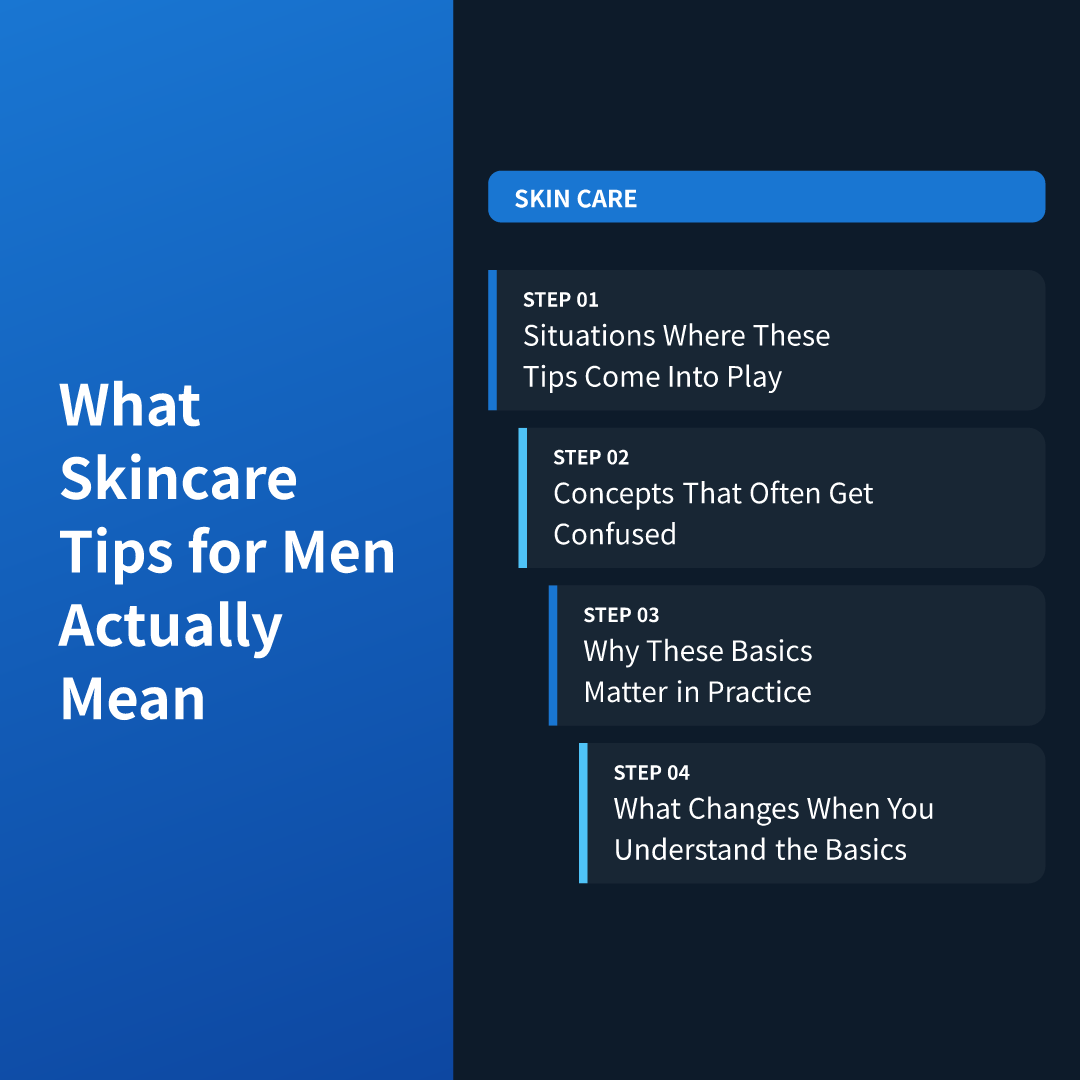
Situations Where These Tips Come Into Play

The advice becomes most useful in a few recurring situations. Knowing which one applies to you keeps a routine short instead of turning it into a shelf of unused bottles.
Shaving and post-shave skin
Shaving removes hair, but it also scrapes the outer skin layer a little. That is why razor burn, redness, and small bumps are common complaints. Many people find that a sharp, clean blade, a lubricating shave product, and a fragrance-free moisturizer afterward make the skin feel calmer, though responses vary.
Ingrown hairs, where a hair curls back into the skin, are particularly common in people with curly or coarse facial hair. Picking at them can lead to inflammation or marks. If bumps become painful, keep returning, or look infected, a dermatologist is the right person to consult.
Oily skin and breakouts
Oil glands are influenced by hormones, so many men notice oiliness and acne starting in the teen years and sometimes continuing well into adulthood. Lightweight, non-comedogenic products, which are labeled to avoid clogging pores, are widely used by people with this pattern. Persistent or scarring acne is a medical concern, and prescription options exist that only a clinician can recommend.
Time outdoors and sun exposure
People who work outside, exercise outdoors, or drive a lot get steady UV exposure, often on the face, ears, neck, and the back of the hands. According to the U.S. Centers for Disease Control and Prevention (CDC) general guidance, shade, protective clothing, hats, sunglasses, and broad-spectrum sunscreen are all part of sun protection. Thinning hair makes the scalp another area worth thinking about.
Dry, cold, or windy conditions
Cold air, indoor heating, and long hot showers can leave skin dry and flaky. Switching to a gentler cleanser and a richer moisturizer is a common adjustment. If dryness comes with intense itching, cracking, or widespread red patches, it may point to a condition like eczema that deserves professional evaluation.
Concepts That Often Get Confused

Several ideas get lumped together in beauty marketing. Separating them helps you read labels more calmly and avoid paying for promises that products cannot make.
Cosmetic care versus medical treatment
Cosmetics are products meant to cleanse, moisturize, or improve appearance. Under U.S. Food and Drug Administration (FDA) rules, a product that claims to treat or prevent a disease is generally regulated differently from an ordinary cosmetic. Acne medicines, prescription creams, and sunscreens fall into regulated categories, and their directions should come from the product label or a pharmacist or doctor rather than from a general article like this one.
Dry skin versus dehydrated skin
Dry skin usually refers to a lack of oil, while dehydrated skin refers to a lack of water. The two can overlap, and even oily skin can feel dehydrated. Moisturizers often combine ingredients that attract water with ingredients that seal it in, which is why a single product can address both feelings for many people.
Men's products versus unisex products
Products marketed to men are not necessarily different in formula. Often the main distinctions are scent, packaging, and texture. A simple way to think about it: a shirt does not work better because it is sold in the men's aisle. What matters is whether the ingredients suit your skin and whether you tolerate them.
Exfoliation versus scrubbing hard
Exfoliation means loosening dead surface cells, either with a physical scrub or with chemical exfoliants such as alpha hydroxy acids or salicylic acid. More is not better. Overdoing it can lead to redness, stinging, and a weakened barrier, especially on freshly shaved skin. Sensitive or acne-prone skin may need a professional's view before adding stronger actives.
Sunscreen versus a moisturizer with SPF
Some moisturizers include SPF (sun protection factor, a measure of protection against UVB rays). They can be convenient, but how well they protect depends on how much is applied and how often it is renewed. Reading the label for broad-spectrum protection and following its directions is the safest way to understand a specific product.
Why These Basics Matter in Practice

Think of the skin barrier like the mortar between bricks in a wall. When it stays intact, the wall holds up to weather. When harsh cleansers, over-exfoliation, or constant shaving wear it down, small problems such as stinging, tightness, and flare-ups tend to follow.
Consistency often matters more than complexity. A short routine that you actually keep up usually beats an elaborate one that you abandon after a week. Results build gradually and differ from person to person, so patience and realistic expectations are part of the plan.
Ingredient basics worth recognizing
- Glycerin and hyaluronic acid: humectants, meaning ingredients that draw water into the skin.
- Ceramides: fats that occur naturally in the skin barrier and are common in moisturizers.
- Niacinamide: a form of vitamin B3 that appears in many products for oil balance and skin comfort, though reactions vary.
- Retinoids: vitamin A derivatives used in some over-the-counter and prescription products; they can cause dryness and irritation, so a pharmacist or dermatologist can explain how to approach them.
- Fragrance and alcohol-heavy formulas: frequent triggers for people with sensitive skin.
Patch testing and irritation
Any new product can cause a reaction, even gentle-looking ones. Allergic or irritant reactions may show up as redness, burning, itching, or swelling. Many dermatology resources, including the AAD, suggest testing a new product on a small area first and introducing one new item at a time, so you can tell which one caused a problem. Stop using a product if it bothers your skin.
When to see a professional
Skincare habits cannot diagnose or resolve every concern. Reach out to a dermatologist or other licensed clinician if you notice any of the following:
- A mole or spot that changes in size, shape, or color, bleeds, or does not heal.
- Persistent, painful, or scarring acne.
- Rashes that spread, blister, or do not improve.
- Signs of infection such as warmth, swelling, pus, or fever.
- Skin reactions after starting a medicine or a new treatment.
The American Academy of Dermatology and the National Cancer Institute both emphasize that changing or unusual skin spots should be examined by a professional rather than monitored indefinitely at home.
Limits worth keeping in mind
No product can promise to erase wrinkles, shrink pores permanently, or stop aging. Marketing language such as "miracle" or "instant" deserves skepticism. Skin also changes with genetics, hormones, sleep, diet, and stress, so what works for a friend may not work for you.
What Changes When You Understand the Basics
Once you see skincare tips for men as ordinary skin care applied to common situations, two decisions get easier.
- You can shop by need, not by label. Instead of choosing a product because it is sold as "for men," you can match it to your skin type, your shaving habits, and your sun exposure, and skip the extras you do not need.
- You can tell habit from health concern. A dry patch after a cold week is a routine matter, while a changing mole, a stubborn rash, or severe acne is a reason to book a visit with a professional rather than add another product.
Disclaimer: This article is for informational purposes only and is not a substitute for professional medical advice, diagnosis, or treatment. Please consult a licensed professional for personal health decisions.
Related reading: How to Store Skincare Products So They Last