How to Choose Skincare on a Budget Without Wasting Money
Two people can have the same skin complaint and need completely different products, which is why knowing how to choose skincare on a budget starts with the cause, not the price tag. A flaky, tight face might come from a weak moisture barrier in one person and from a harsh cleanser in another. Buying the wrong fix for the wrong cause is the most common way money disappears from a skincare shelf.
This guide is written from an editor's point of view, not a clinician's. It sorts common concerns into likely causes, explains how to tell which one you might be dealing with, and points out where spending more rarely helps. Skin varies a lot between individuals, so treat everything here as general information rather than personal advice.
Why the Same Skin Problem Can Have Different Causes
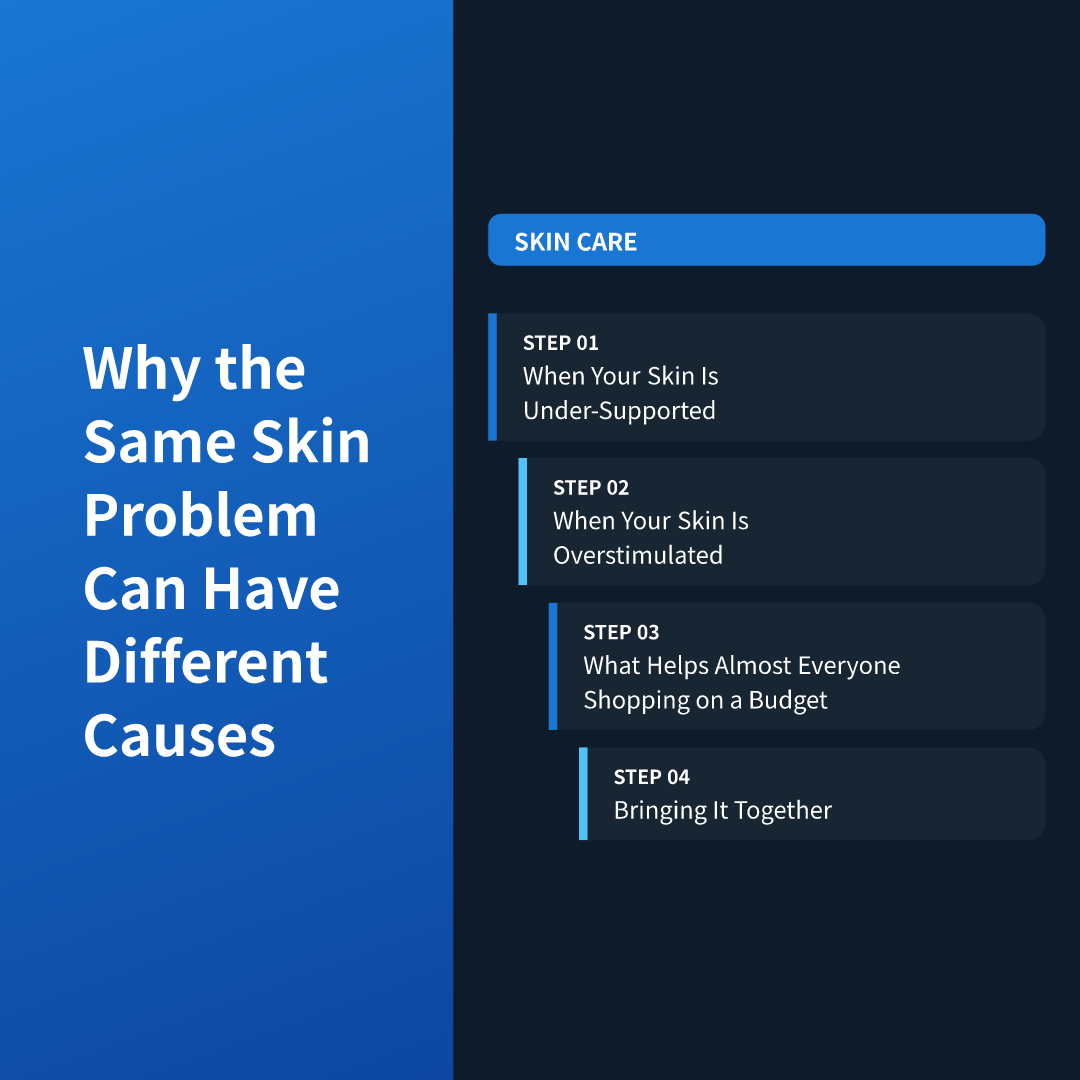
Dryness, redness, breakouts, dullness, and rough texture are symptoms, not diagnoses. Each one can come from several directions, and the product that helps one cause may do nothing, or make things worse, for another.
For a budget shopper, the practical question is simple: is the problem mostly about missing support (not enough moisture, no sun protection, a gentle routine that is too minimal), or mostly about too much stimulation (too many actives, over-cleansing, over-exfoliating)? Those two branches lead to nearly opposite shopping lists.
There is also a third possibility that sits outside any product aisle: a skin condition that needs professional evaluation. Persistent, painful, or rapidly changing skin problems are better handled by a licensed professional than by trial and error.
A quick way to sort your starting point
Think about what changed recently. Did the trouble begin after adding a new product, a stronger active, or a new cleansing habit? Or has it been steady for a long time, with a routine that is already very simple? Your answer usually points toward one of the two branches below.
If neither fits, or if the skin is itchy, swollen, blistering, or sore, that is a signal to stop guessing. The American Academy of Dermatology offers general guidance on when skin concerns warrant a visit to a board-certified dermatologist, and that is a better use of money than a cabinet full of experiments.
When Your Skin Is Under-Supported
How to tell if this is you
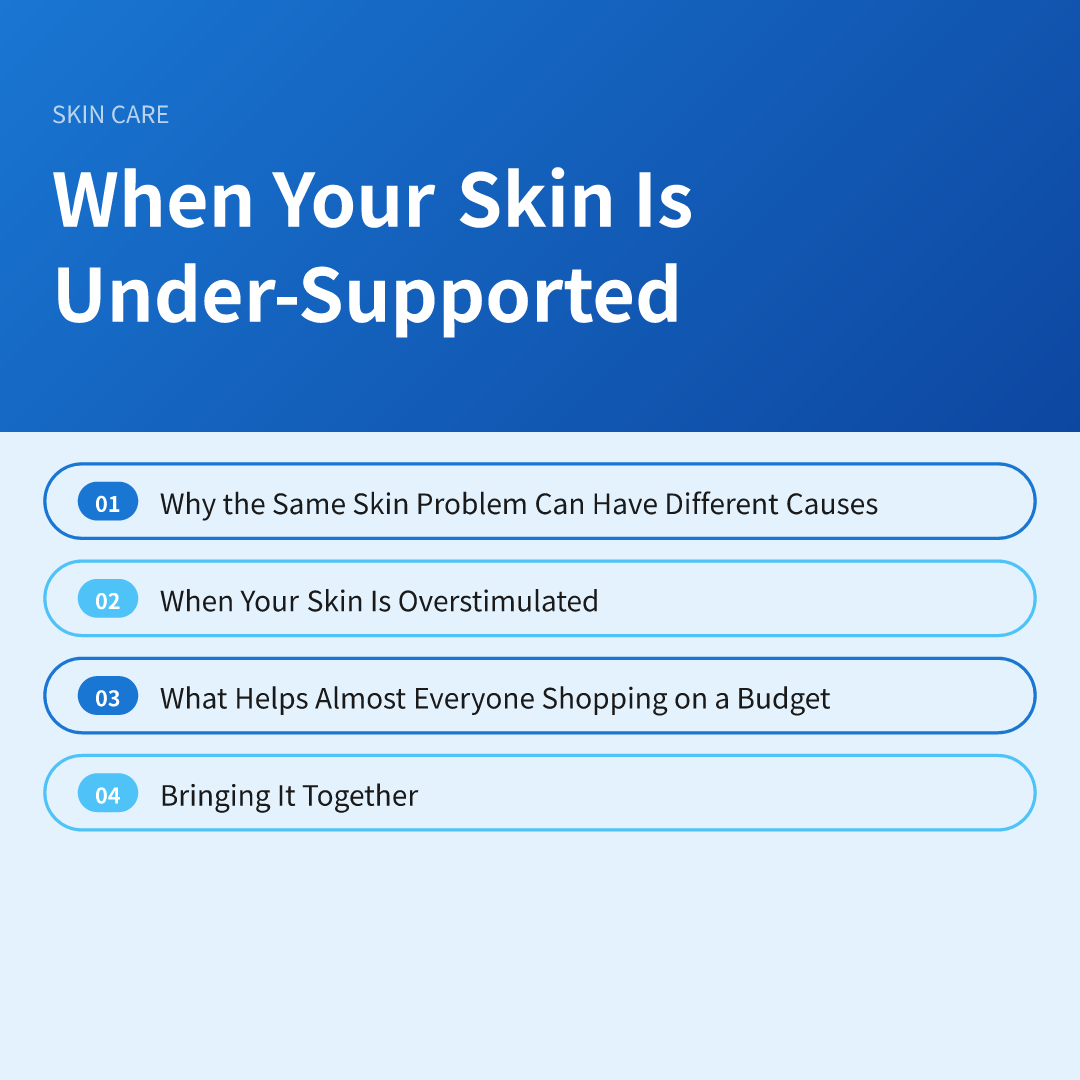
Under-supported skin tends to feel tight after washing, look dull or patchy, and sometimes show fine flaking. Makeup may cling to dry spots. The routine behind it is often very bare: a quick rinse, maybe nothing else, and little attention to daily sun exposure.
It also helps to notice whether the skin feels better soon after a basic moisturizer. If comfort improves without any stinging, that hints the issue is more about hydration and protection than about needing something stronger.
What usually helps on a small budget
For this branch, the budget-friendly core is short: a gentle cleanser, a plain moisturizer, and a daily sunscreen. The U.S. Food and Drug Administration notes that sunscreens are regulated as over-the-counter products in the United States, and labels such as broad spectrum can help you compare options on the shelf. For how to use a particular sunscreen, follow the product label and ask a pharmacist or clinician if you have questions.
Pharmacy and drugstore brands often use simple, widely used ingredients such as glycerin, ceramides, petrolatum, or hyaluronic acid. Those ingredient names are common across price levels, and a higher price does not automatically mean better results. Fragrance-free formulas are often favored by people with sensitive skin, though reactions vary from person to person.
What gets wasted if you guess wrong
If your skin is actually irritated rather than under-supported, piling on richer creams and layered serums may not solve anything and can add more things that sting. Likewise, buying an expensive serum before you have a steady moisturizer and sunscreen usually means paying for the finishing touch before the foundation.
Related reading: Skincare Routine for Sensitive Skin: Build It Around Habits You Already Have
When Your Skin Is Overstimulated
How to tell if this is you
Overstimulated skin often stings when you put on products that used to feel fine. It may look red or shiny yet feel rough, and it can flake even though you are using plenty of moisturizer. A common pattern is a routine that grew over time, with a new cleanser, a new exfoliating product, a new treatment, and no clear sense of which one started the trouble.
Another clue is that the skin seems to get worse the more you do. If simplifying for a while feels calmer, irritation from the routine itself may be part of the picture.
What usually helps on a small budget
This is the branch where spending less often works in your favor. Many people find it useful to pare back to a gentle cleanser, a plain moisturizer, and sunscreen, then reintroduce other products one at a time so a reaction can be traced. The American Academy of Dermatology provides general information on irritant and allergic reactions to skincare, including why patch testing new products is commonly discussed.
Introducing one new product at a time also protects your wallet. If you add three things at once and your skin reacts, you cannot tell which one to return, and you may end up discarding all of them.
What gets wasted if you guess wrong
If the real issue is a thin, under-moisturized barrier, cutting back everything may leave you without the basics. And if the issue is overstimulation, buying a soothing serum on top of a routine that is still too busy rarely fixes the underlying cause. The cheapest fix in this branch is often fewer products, not different ones.
Related reading: A Simple Skincare Routine for Dry Skin: Start Small
What Helps Almost Everyone Shopping on a Budget
Whichever branch fits you, a few habits make a limited budget go further. None of them guarantee a particular result, but they reduce common waste.
- Read the ingredient list, not just the front label. Marketing terms like "dermatologist-inspired" or "clean" have no single fixed meaning, while the ingredient list is regulated labeling.
- Compare by ingredient function, not brand. Plain moisturizers from different price tiers often share similar core ingredients.
- Prioritize sunscreen. Daily sun protection is commonly described by public health agencies as a foundation of skin care, and it tends to outlast trends.
- Be cautious with bundles and sets. A discounted set of six products can cost more in the end if you only need two.
- Buy small sizes first. Trying a travel size before committing to a large bottle lowers the cost of a mistake.
- Watch the return policy. Some retailers accept returns on skincare, which can soften the cost of a bad fit.
Treat active ingredients with extra care
Ingredients such as retinoids, exfoliating acids, and vitamin C are popular, and they are also the products most likely to irritate if the skin is not ready. The right strength, frequency, and combination depend on your skin and on the specific product, so follow the label and ask a pharmacist or licensed professional before starting something new, especially if you have a skin condition, are pregnant, or are nursing.
Prescription-strength versions exist for some of these ingredients. Those decisions belong with a clinician rather than with a shopping guide.
Be skeptical of dramatic promises
Cosmetics are generally meant to cleanse or beautify, and the FDA distinguishes them from products that claim to treat or prevent disease. If a budget product promises to erase a skin condition, or claims results overnight, that is a reason to look more closely. Realistic expectations are that most cosmetic changes happen gradually and differ from one person to the next.
Do not let price decide for you
Expensive does not mean unsafe or ineffective, and cheap does not mean low quality. What matters more is whether the formula suits your skin and whether you will actually use it consistently. A modest moisturizer used every day usually serves you better than a luxury one that sits unopened because it irritates you.
Bringing It Together
Choosing skincare on a budget comes down to identifying the likely cause before you buy. If your skin feels tight, dull, or bare, it may be under-supported, and a gentle cleanser, a plain moisturizer, and daily sunscreen are a sensible, affordable base. If it stings, looks red, and gets worse with more products, it may be overstimulated, and simplifying and reintroducing items one at a time can save both skin and money.
When you cannot tell which branch you are on, a few options are available. You can pare the routine down to basics for a while and watch how your skin responds, you can ask a pharmacist for help comparing simple products, or you can book a visit with a licensed dermatologist if the problem is persistent, painful, or changing. Those steps cost far less than a shelf of products bought on a hunch.
Results vary, and nobody can promise how a specific product will behave on your skin. But if you start with the cause, keep your routine short, and treat price as only one factor, you give your budget the best chance to go toward things that fit. That is the heart of how to choose skincare on a budget: understand the problem first, then buy the smallest set of products that addresses it.
Disclaimer: This article is for informational purposes only and is not a substitute for professional medical advice, diagnosis, or treatment. Please consult a licensed professional for personal health decisions.