How to Store Skincare Products So They Last
Knowing how to store skincare products starts with figuring out what is actually going wrong, because a cloudy serum, a separated cream, and a stinging moisturizer can each have a different cause. Heat, light, air, water, and bacteria all affect products in different ways, and the fix for one does little for another. Storage will not rescue a formula that was never stable, but it often makes a real difference for the ones that were.
Below, the common storage problems are split by cause, with a way to check which one you are dealing with and what usually helps. Products vary widely, so the label and the brand's own guidance always come first.
Sorting Out What Is Actually Going Wrong

The same symptom can come from different places. A cream that smells off might have been kept in a hot bathroom, or it might have been contaminated by fingers dipped into the jar. If you guess wrong, you can end up buying a mini fridge when the real culprit was a lid left loose on the counter.
Most storage trouble falls into a few groups:
- Heat and temperature swings: products that sit near a window, a hair dryer, a heated towel rail, or in a parked car.
- Light exposure: products in clear bottles on a sunny shelf.
- Air and moisture: jars left open, pump tips that dry out, or steamy shower shelves.
- Contamination: fingers, shared applicators, and tools that are not cleaned.
- Age: a product that was stored perfectly but has simply been open for a long time.
Before changing anything, look at the product itself. Note any change in color, texture, smell, or how it feels on the skin, and note where it has been living. That combination usually points to one of the groups above.
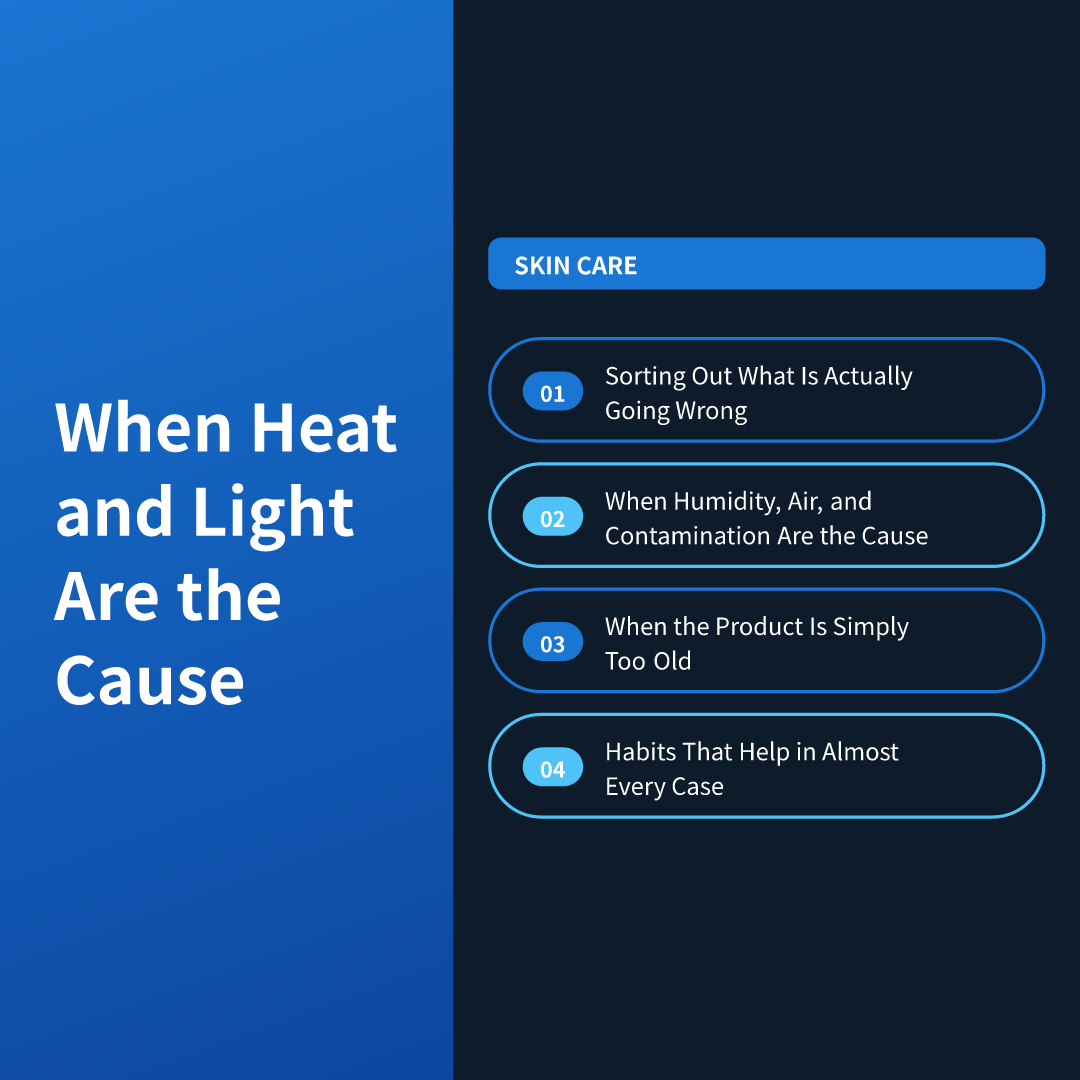
When Heat and Light Are the Cause
How to tell if this is your situation
Think about where the product spends its time. A bottle on a windowsill, a bag left in a hot car, or a shelf above a radiator is a likely suspect. Signs people commonly report include a formula that has changed color, separated into layers, turned runnier or grainier than it was, or developed a different smell. Vitamin C products and some retinoid formulas are often described by brands as sensitive to light and air, which is why many come in dark or opaque packaging.
Be careful with the diagnosis, though. Some creams naturally change slightly in texture with temperature, and a color shift does not always mean the product has gone bad. A visible change is a reason to check the brand's guidance, not proof of a specific problem.
What usually helps
Brands generally recommend keeping products in a cool, dry place away from direct sunlight, and many list this on the packaging or website. A drawer, a closet shelf, or a cabinet away from the shower and outer walls is a common choice. Products in dark glass or opaque tubes are designed to limit light exposure, so keeping them in that packaging is usually better than decanting them into clear containers.
Some products carry a label asking for refrigeration, and the brand will say so if that is the case. Others are fine at room temperature, and cold storage is not automatically better. A very cold fridge can change the texture of some creams or cause certain formulas to separate, so follow what the manufacturer states for that specific product.
If you guessed wrong
Moving everything into the fridge is a common overcorrection. It costs space and effort, and it may not help a product whose real problem is contamination or age. It can also make some textures unpleasant to use. If your products were already kept somewhere cool and dark, look at the next causes before changing your setup.
When Humidity, Air, and Contamination Are the Cause
How to tell if this is your situation
Look at how you actually use the product. Do you dip fingers into a jar? Is a lid sometimes left off or not fully closed? Do products live on a shower ledge or beside the sink where steam and splashes reach them? Do you share makeup sponges, spatulas, or brushes without cleaning them? Signs people often notice include an unusual smell, visible specks or fuzzy spots, a watery layer on top of a cream, or skin that suddenly reacts to a product it used to tolerate.
A reaction on its own does not prove contamination, since skin can become irritated for many reasons. If you notice mold-like growth, a sour or rancid smell, or irritation that keeps happening, it is generally sensible to stop using that product and talk with a pharmacist or a dermatologist about persistent skin reactions.
What usually helps
The most common advice from brands and consumer safety guidance is simple. Close lids firmly after each use, keep products out of wet areas where possible, and avoid introducing water into jars. Many people find that pump bottles and tubes are easier to keep clean than open jars because less skin touches the formula. If a product comes with a small spatula, using a clean one instead of fingers is a habit brands often suggest.
According to the U.S. Food and Drug Administration, cosmetics can become contaminated with microorganisms during use, and the agency's consumer guidance encourages keeping containers closed and avoiding the sharing of products and applicators. Eye-area products get particular attention in that guidance because of the sensitivity of the area, so check the brand's advice on how long to keep them after opening.
Tools matter as much as the products. Makeup sponges, brushes, and facial tools can hold residue and moisture, so cleaning them as the manufacturer describes is part of storage, not a separate chore.
Related reading: How to Clean Makeup Brushes Without Wrecking Them
If you guessed wrong
Buying a new, expensive product and keeping the same habits tends to repeat the problem. If the cause was fingers or a wet shelf, the replacement can be affected in the same way. Changing the habit first is usually a cheaper place to start.
When the Product Is Simply Too Old
How to tell if this is your situation
If storage has been sensible and the product still seems off, age may be the answer. Many products carry a small open-jar symbol showing how many months the formula is intended to last after opening. Some people write the opening date on the container so they can keep track. Without that, it can be hard to remember when something was first used.
Products with active ingredients, natural oils, or minimal preservatives are often described by brands as having shorter useful lives, though this varies a great deal between formulas. Sunscreen is a case where age matters for a particular reason. Sunscreen is regulated as a drug in the United States, and the FDA notes that sunscreens are expected to remain effective for a set period, generally indicated by an expiration date on the package or, for those without one, a shelf life guidance in the rules. If your sunscreen is past its date, or has changed in look or texture, replacing it is the usual advice.
What usually helps
Checking the open-jar symbol, noting the date of first use, and being willing to let go of products that have been open a long time are the practical steps. The period after opening is only an estimate, and storage conditions can shorten it. A product kept in warm, bright conditions may not last as long as the symbol suggests.
If you are unsure whether something is still good, the brand's customer service can often tell you how to read the batch code or what shelf life to expect. When a product has clearly changed in smell, color, or consistency, many people simply replace it rather than risk irritating their skin.
Related reading: How to Read a Skincare Ingredient List (Without Guessing)
If you guessed wrong
Throwing out a product that was fine wastes money, while keeping one that has genuinely spoiled risks irritation. When the signs are unclear, the cost of replacing a lower-priced item is usually small compared with dealing with a skin reaction, though how you weigh that is a personal call.
Habits That Help in Almost Every Case
Some storage habits are useful whatever the cause, and they are easy to adopt without overhauling your routine.
- Keep the original packaging. It carries the instructions, the batch code, and the open-jar symbol, and it was chosen to protect the formula.
- Read the label. Storage notes differ by product, and the brand's guidance outweighs general tips.
- Choose a stable spot. A drawer or cabinet away from windows, heat, and steam is a common option for most products.
- Handle products gently. Clean hands and clean tools reduce the chance of introducing unwanted microbes.
- Travel thoughtfully. Heat in cars and luggage can stress formulas, so avoid leaving products in places that get very hot.
- Do not decant casually. Moving a product into an unlabeled or unclean container can add contamination and lose the safety information printed on the original.
Bathrooms deserve a special mention. They are convenient, but they are also warm and humid, which is not ideal for many products. Moving the items you use most to a nearby drawer or shelf outside the shower area is a small change many people find workable.
A product that is stored well will not necessarily perform better than its formula allows, but a product stored poorly can lose some of what it was designed to do.
Conclusion
How to store skincare products depends on what is causing the trouble. If the problem looks like heat or light, a cool, dark, dry spot and the original packaging usually address it. If it points to humidity, air, or contamination, tighter lids, cleaner habits, and keeping products out of steamy areas tend to matter more. If the product is simply old, tracking the opening date and replacing it when it has changed is the sensible route.
When you cannot tell which cause applies, start with the least costly step: read the label, check the open-jar symbol, and move the product away from heat and moisture. If skin reactions continue, or you are dealing with a prescription or drug-regulated product such as sunscreen or an acne treatment, ask a pharmacist or a dermatologist before deciding what to keep. Reactions vary from person to person, so personal guidance is worth more than a general rule.
Disclaimer: This article is for informational purposes only and is not a substitute for professional medical advice, diagnosis, or treatment. Please consult a licensed professional for personal health decisions.