How to Read a Skincare Ingredient List (Without Guessing)
The same confusing label can come from very different problems, and that's why "just read the ingredients" often isn't enough advice on its own. Some people struggle because the names are unfamiliar chemistry terms. Others understand the words but have no idea what the order on the list actually means. Knowing how to read a skincare ingredient list starts with figuring out which of these is actually tripping you up, because the fix is different for each one.
This matters more than it might seem. A moisturizer that looks "clean" based on a quick glance might contain the exact ingredient that's been irritating your skin for months, just listed under a name you didn't recognize. Sorting out the real cause of your confusion first saves you from wasted product purchases and misplaced trust in marketing claims.
Why Ingredient Labels Feel Confusing in the First Place
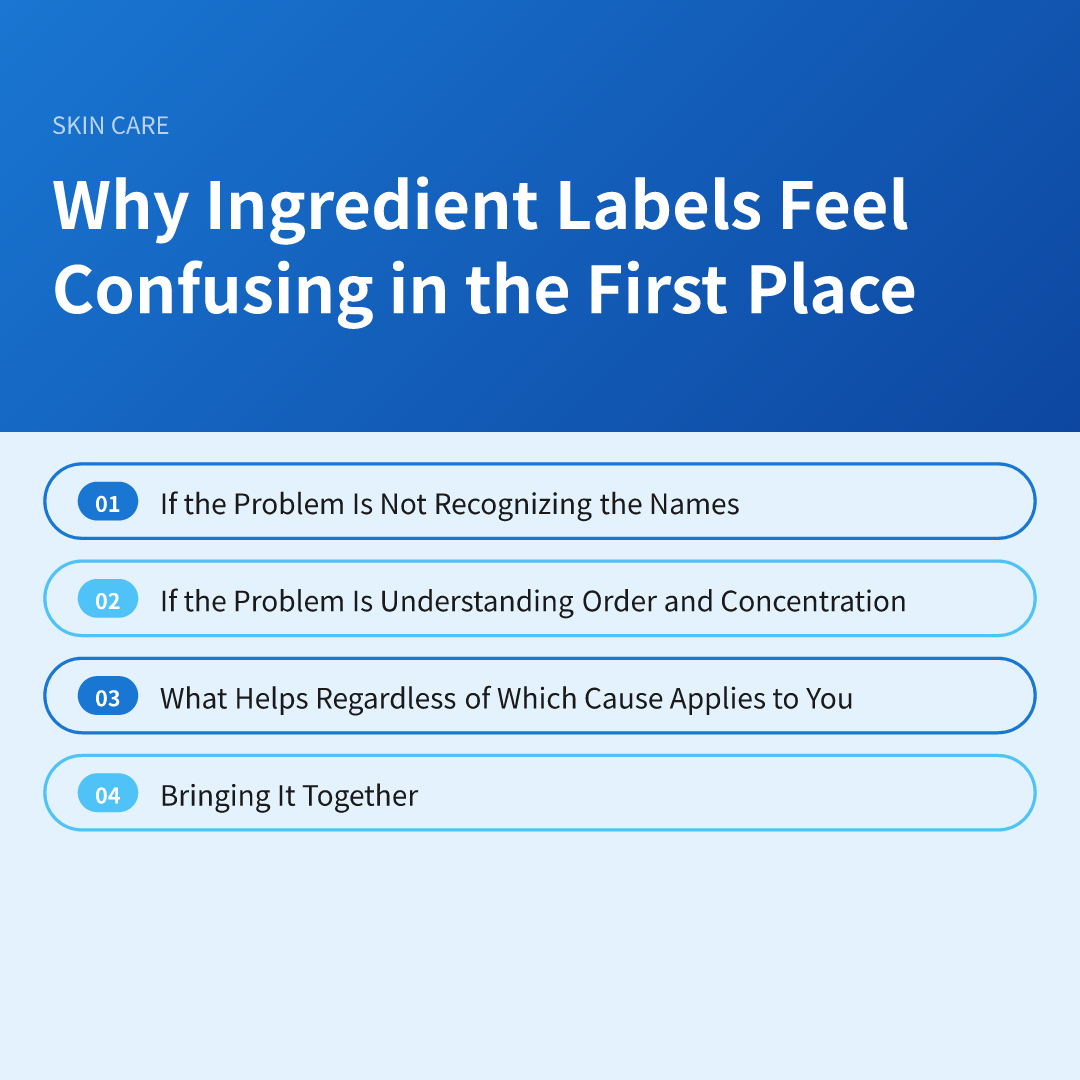
Before fixing anything, it helps to separate the two most common sources of confusion. They look similar on the surface — both leave you staring at a long list of words — but they need different approaches.
- Cause A: Unfamiliar naming. The list uses INCI (International Nomenclature of Cosmetic Ingredients) names, which are scientific or Latin-derived terms rather than everyday words. "Tocopherol" doesn't obviously mean vitamin E to most readers.
- Cause B: Not knowing what order and position mean. Even when someone recognizes an ingredient name, they may not realize that ingredients are generally listed from highest to lowest concentration, or that being near the bottom of the list changes how much that ingredient likely matters.
Mixing these two up is where a lot of wasted effort happens. Someone who struggles with naming might buy an ingredient dictionary app, which helps a little, but still misunderstands why a "good" ingredient listed last on the label may not do much. Someone who struggles with ordering might already know every name but still can't judge whether a product is actually built around an active ingredient or just contains a trace amount for the marketing copy.
If the Problem Is Not Recognizing the Names
How to check if this is your situation
This is likely your main issue if you find yourself needing to look up almost every third word, or if you've been surprised to learn that an ingredient you were avoiding was hiding under a different name. A common example: someone trying to avoid alcohol-based products may not realize that "cetearyl alcohol" behaves very differently from "alcohol denat," even though both include the word "alcohol."
What tends to help in this case
Keeping a short personal reference list of the specific ingredient names relevant to your own skin concerns tends to be more useful than trying to memorize every INCI term that exists. If you've had a reaction to a specific ingredient before, it's worth asking a dermatologist or pharmacist what its common alternate names or related compounds are, since cosmetic chemistry often has several names for closely related substances.
Free ingredient-checking databases and apps can also help translate INCI names into plain language, though it's worth remembering these tools vary in accuracy and aren't a substitute for professional guidance if you have a known allergy or sensitive skin condition. For readers who want an official reference point, the U.S. FDA's page on cosmetic ingredient labeling is a reasonable starting point for understanding how these lists are regulated.
The waste to avoid here: spending money on "ingredient decoder" courses or elaborate spreadsheets when what you really need is a short, personalized list of the two or three ingredients that actually matter for your skin — everything else on the label is often secondary to those.
If the Problem Is Understanding Order and Concentration
How to check if this is your situation
This is more likely your issue if you already recognize most ingredient names but still can't tell whether a product with "niacinamide" on the label is actually formulated to be effective, or if it just contains a small amount for the label appeal. You might also notice you're unsure why two products with the same active ingredient seem to behave so differently on your skin.
What tends to help in this case
Ingredients are generally listed in descending order of concentration until about the one percent mark, after which many brands list remaining ingredients in any order, since regulations mostly require accuracy at the higher end rather than a strict ranking for tiny amounts. This means an active ingredient's position relative to preservatives, fragrance, or thickeners near the middle of the list can give a rough sense of how much of it is actually present.
A practical habit is comparing where your key ingredient sits relative to water (often listed first) and common filler ingredients like glycerin or dimethicone. If an active sits close to the very end of a long list, it's reasonable to be skeptical about how much it's contributing, even if the front of the packaging highlights it prominently.
Ingredient order gives a general sense of formulation priority, but it isn't an exact percentage breakdown — brands aren't required to disclose precise concentrations for most ingredients.
The waste to avoid here: assuming any product listing a trendy active ingredient will work the same way as another product with that same ingredient higher on the list. Two "vitamin C serums" can behave very differently depending on formulation, concentration, and stability, not just the presence of the word on the label.
What Helps Regardless of Which Cause Applies to You
Some habits are useful no matter which of the two issues above is closer to your situation. These aren't shortcuts that replace understanding the label, but they reduce the day-to-day guesswork.
- Patch testing new products on a small area before applying them to your whole face remains a reasonable general habit, since even well-understood ingredients can trigger individual reactions that ingredient reading alone can't predict.
- Tracking your own reaction history in a notes app, including product names and ingredient lists, makes it much easier to spot patterns over time instead of relying on memory.
- Being cautious with fragrance and essential oil listings is generally worthwhile if you have sensitive or reactive skin, since these are commonly cited as frequent sources of irritation, though individual tolerance varies a lot.
- Not judging a product by a single "hero" ingredient — the overall formulation, pH, and how ingredients interact often matter as much as any one component.
It's also worth being realistic about the limits of self-education here. Reading labels can help you avoid known irritants and make more informed comparisons between products, but it doesn't replace a professional evaluation if you're dealing with a persistent rash, breakouts that won't resolve, or a suspected allergy. In those cases, a dermatologist can help identify the actual trigger, sometimes through patch testing that goes well beyond what any label-reading skill can determine on its own.
When the Label Alone Won't Give You an Answer
Some situations go beyond what ingredient reading can resolve, and it helps to recognize them early rather than cycling through more products. If you've already identified a suspect ingredient but reactions continue with products that clearly exclude it, something else may be going on — a skin barrier issue, an unrelated condition, or a sensitivity to a related compound not yet on your radar.
If you're pregnant, managing a diagnosed skin condition, or using prescription topical treatments, ingredient interactions can be more complex than a general list-reading approach can account for. A conversation with a dermatologist or your prescribing clinician is the more reliable route in those cases, since they can factor in your specific medical history in a way a label can't.
Bringing It Together
To recap the two branches: if unfamiliar names are the core problem, the fix is building a short personal reference of ingredients that matter to you rather than trying to learn every chemical term at once. If the confusion is about order and concentration, the fix is learning to read position on the list as a rough — not exact — indicator of how much an ingredient is actually doing in that formula.
If you're genuinely unsure which category fits you, a reasonable middle step is picking one product you already own, looking up every ingredient name once using a reputable database, and then noting where your known active ingredients sit on the list. Doing this for even a couple of products tends to reveal pretty quickly whether your gap is vocabulary or structure.
Learning how to read a skincare ingredient list isn't about becoming a cosmetic chemist — it's about knowing enough to ask better questions, both of the products you're considering and, when something isn't working, of a professional who can look at your skin directly rather than just at a label.
Disclaimer: This article is for informational purposes only and is not a substitute for professional medical advice, diagnosis, or treatment. Please consult a licensed professional for personal health decisions.
Related reading: What Order to Apply Skincare Products, Really