How to Pick a Cleanser for Dry Skin
The best way to pick a cleanser for dry skin is to look for a gentle, low-foaming formula that cleans without leaving the skin tight, and to avoid strong fragrance and harsh surfactants. Dry skin tends to have a weaker moisture barrier, so a cleanser that feels squeaky-clean can often leave it feeling worse. Reactions vary from person to person, so the right choice depends on your skin, your climate, and what else is in your routine.
Most people with dry skin know the feeling: you wash your face, and within minutes it feels tight, rough, or a little itchy. Maybe flakes show up around the nose or cheeks, and moisturizer seems to disappear. It is easy to blame the moisturizer and keep swapping products, when the cleanser may be quietly undoing the work. Fixing this is less about finding one magic product and more about doing things in a sensible order.
Related reading: Skincare Routine for Sensitive Skin: Build It Around Habits You Already Have
Figuring Out What You Are Actually Dealing With

Before you shop, it helps to name the problem. Dry skin and dehydrated skin are often mixed up. Dry skin generally lacks oil, while dehydrated skin lacks water and can happen even in people who feel oily. Both can feel tight after washing, but they may respond to different habits.
The American Academy of Dermatology general guidance describes dry skin as something that can be influenced by weather, hot water, harsh soaps, and certain skin conditions. That last part matters. Persistent dryness with redness, scaling, or intense itching can sometimes be linked to conditions such as eczema, which is a reason to talk with a qualified professional rather than guess.
Signs your current cleanser may be part of the problem
- Your face feels tight or “squeaky” right after rinsing.
- Dry patches appear or worsen soon after you start a new cleanser.
- Stinging or burning shows up when you wash, especially around the eyes and mouth.
- Your moisturizer seems to sting more than it used to.
- You notice redness that fades slowly after cleansing.
None of these prove the cleanser is the culprit, since weather, other products, and skin conditions can all play a role. Still, they are useful clues, and they make the next steps easier to plan.
Step 1: Right Now, Read the Label and Rule Out the Usual Suspects

The first step is a quick audit of what you already own. Here is how to think it through, using a what, how, and why approach.
- What: Check the cleanser format. How: Look at whether it is a gel, foam, cream, lotion, balm, or oil. Why: Cream, lotion, and balm cleansers are commonly chosen by people with dry skin because they tend to feel less stripping, while strong foaming gels are often a better match for oilier skin. Individual skin can differ, so treat this as a starting point.
- What: Scan for fragrance and strong actives. How: Read the ingredient list for added fragrance, essential oils, and high-strength exfoliating acids. Why: Fragrance is a frequently reported trigger for irritation, and exfoliating ingredients in a wash-off product may add to dryness for some people.
- What: Look at the cleansing agents. How: Find the surfactants, which are usually near the top of the list. Why: Some surfactants are considered harsher than others, and milder ones are often marketed as gentle or sulfate-free. Marketing terms are not tightly standardized, so the ingredient list tells you more than the front of the bottle.
- What: Check for supportive ingredients. How: Notice whether the formula includes humectants such as glycerin or hyaluronic acid, and skin-softening ingredients such as ceramides or plant oils. Why: These are commonly used in products aimed at dry skin, though a cleanser is on your skin only briefly, so do not expect it to replace a moisturizer.
A cleanser’s main job is to remove dirt, sunscreen, and excess oil without stripping the skin. Moisturizing is mostly the job of what comes after.
A quick note on the “pH-balanced” label
You will see “pH-balanced” or “low pH” on many bottles. Skin is naturally slightly acidic, and many people prefer cleansers formulated closer to that range. But the term is used loosely, and a pH claim alone does not guarantee a product will suit sensitive or dry skin.
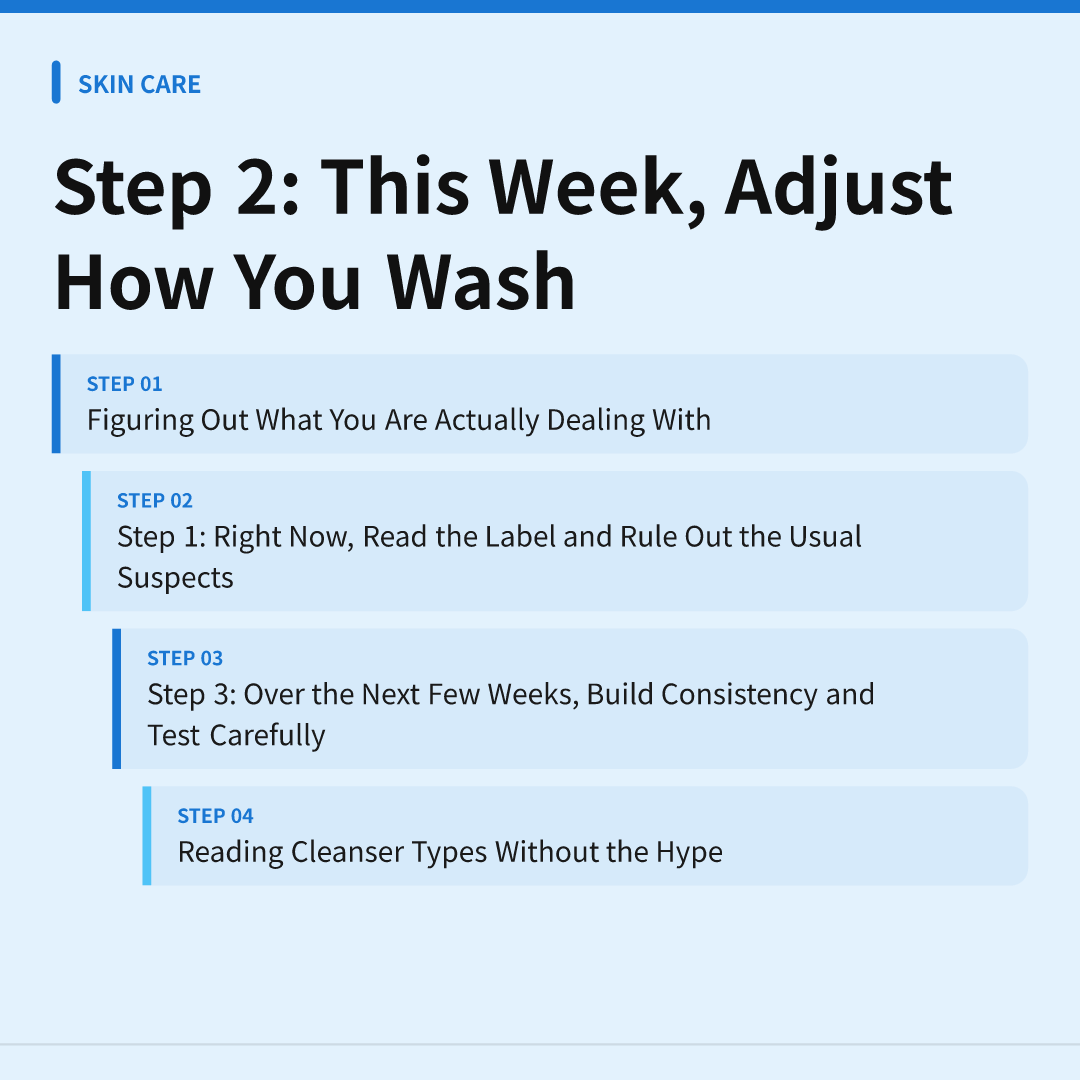
Step 2: This Week, Adjust How You Wash
Even a well-chosen cleanser can disappoint if the technique works against it. Over the next several days, small changes in habit are worth trying, since they cost nothing.
- What: Lower the water temperature. How: Use lukewarm water rather than hot. Why: The American Academy of Dermatology general guidance notes that very hot water can worsen dryness, so many routines for dry skin avoid it.
- What: Keep cleansing brief. How: Massage the cleanser gently with your fingertips rather than scrubbing with a rough cloth or brush. Why: Friction and long contact time can add to irritation for skin that is already dry.
- What: Pat dry. How: Use a soft towel and dab rather than rub. Why: Rubbing can aggravate sensitive areas, and leaving the skin slightly damp before moisturizer is a common approach to help it hold on to water.
- What: Consider how often you cleanse. How: Some people with dry skin simplify the morning to a water rinse and keep the fuller cleanse for the evening. Why: Fewer washes may mean less stripping, though if you wear sunscreen or makeup, a proper evening cleanse is usually still useful.
If you wear heavy sunscreen or makeup, an oil or balm cleanser followed by a gentle cream cleanser is a pairing some people like. It is not required, and plenty of people do fine with a single mild product.
Step 3: Over the Next Few Weeks, Build Consistency and Test Carefully
Skin rarely changes overnight, and a new cleanser is hard to judge after one wash. Giving a product time, while watching for warning signs, usually gives a clearer picture.
Introduce one change at a time
If you switch your cleanser, moisturizer, and treatment products all at once, it becomes nearly impossible to tell what helped or what caused a flare. Changing one product, then waiting, makes the cause easier to spot. This is a plain, practical habit rather than a rule.
Patch testing
Many people try a new product on a small area first, such as along the jawline or behind the ear, to see how skin reacts before using it more widely. The American Academy of Dermatology general guidance mentions patch testing as a common way to check for sensitivity. It does not guarantee a product will be tolerated, because some reactions develop slowly.
Pair the cleanser with a moisturizer routine
A gentle cleanser works best as one part of a routine. Many people with dry skin follow cleansing with a moisturizer, and sunscreen in the morning. The details, such as which moisturizer texture suits you, depend on your skin and climate.
- In dry or cold seasons, richer textures are often preferred.
- In humid seasons, lighter lotions may feel more comfortable.
- With indoor heating or air conditioning, skin can feel drier than the weather suggests.
Related reading: How to Choose a Moisturizer for Oily Skin
Things that can make dry skin harder to manage
- Layering several exfoliating or retinoid-type products alongside a cleanser.
- Using scented bar soaps on the face.
- Very long, hot showers.
- Skipping moisturizer because the skin “feels fine” for the moment.
If you use prescription or over-the-counter treatment products for acne, rosacea, or other concerns, how they interact with your cleanser is a question for a pharmacist or clinician. Product directions and professional advice should guide how those are used.
Reading Cleanser Types Without the Hype
Because the product aisle is crowded, a short guide to common formats can help. These are general tendencies, not rules, and individual reactions vary.
- Cream and lotion cleansers: Often rinse off or wipe off, and are commonly chosen for dry or sensitive skin because they tend to feel soft.
- Balm and oil cleansers: Frequently used to dissolve sunscreen and makeup. Some people find they leave a film, so a second gentle cleanse may feel better.
- Gel cleansers: Many are designed for normal to oily skin, though milder, hydrating gels exist that some dry-skin users tolerate.
- Foaming cleansers: Often feel more stripping to dry skin because of how they clean, but formulas differ a lot, so the label matters more than the category.
- Micellar water: Convenient for light cleansing, though some formulas call for rinsing and others do not, so product directions are worth reading.
- Bar cleansers: Some are formulated as gentle syndet bars, while traditional soap bars can be more alkaline and drying for some skin.
No category is automatically right or wrong. If a product feels comfortable, does not sting, and leaves your skin feeling calm after rinsing, that is a reasonable sign it suits you at the moment.
Cosmetic Limits Worth Remembering
A cleanser is a cosmetic product. The U.S. Food and Drug Administration general guidance distinguishes cosmetics, which are meant to cleanse or beautify, from drugs, which are intended to treat or affect the body. That means a cleanser can be gentle and pleasant, but it is not designed to treat a skin condition.
Labels such as “dermatologist-tested” or “hypoallergenic” are not a promise that a product will work for you. They can be a useful starting point, but your own reaction matters more than the wording on the package.
When a New Cleanser Is Not Enough
Sometimes the cleanser is not the main issue. If you have changed to a gentle formula, adjusted your habits, and given it a fair amount of time, but your skin still feels uncomfortable, it may be time to bring in a professional.
Consider reaching out to a dermatologist or another qualified clinician if you notice any of the following:
- Persistent redness, scaling, or itching that does not settle with gentler habits.
- Cracked, painful, or weeping skin.
- Rashes that spread, blister, or appear suddenly after starting a product.
- Dryness along with swelling, signs of infection, or discomfort that affects sleep or daily life.
- Skin that reacts to nearly every product you try.
The National Institutes of Health general guidance on skin health notes that ongoing dryness and itching can be associated with several underlying conditions, and that a professional can help sort out the cause. A clinician can also advise whether a prescription or other treatment is appropriate, which is a decision that should never rest on a cleanser alone. If a reaction seems severe, such as facial swelling or trouble breathing, seek urgent medical care.
Choosing a cleanser for dry skin comes down to a gentle formula, a mindful washing routine, and patience while you watch how your skin responds. Start with the label, adjust your habits, change one thing at a time, and let a qualified professional take over when your skin is not improving. Individual results differ, so what works well for someone else may need tweaking for you.
Disclaimer: This article is for informational purposes only and is not a substitute for professional medical advice, diagnosis, or treatment. Please consult a licensed professional for personal health decisions.