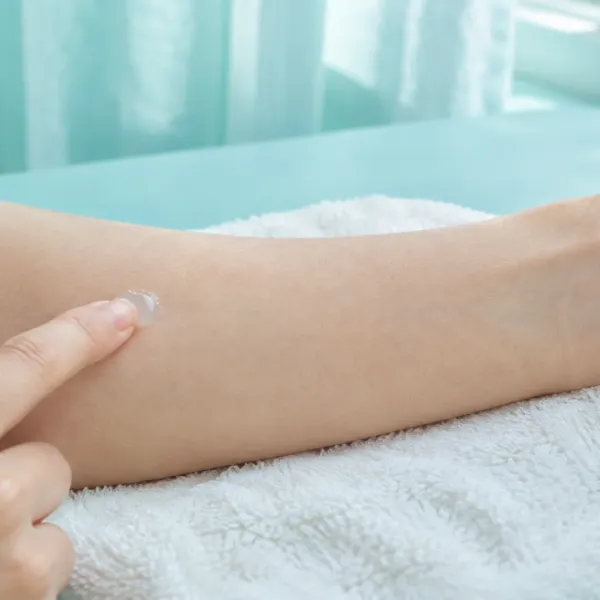
Why Does Skin Sting When You Apply a Serum?
Skin stinging after a serum usually means the product is reaching nerve endings faster or more easily than your skin is comfortable with, often because the outer barrier is thin, dry, or irritated, or because an ingredient is naturally reactive. It does not always signal damage, but it is a signal worth reading. Picture the surface of your face a few seconds after a serum lands: the liquid spreads over a layer of flattened cells, slips into tiny gaps, and brushes against sensory nerve endings sitting just beneath. That brief moment explains most of what you feel.
What Happens in Your Skin the Moment a Serum Lands

The outermost layer of skin, the stratum corneum, is often described as a brick-and-mortar wall: flat cells (the bricks) held together by lipids such as ceramides, cholesterol, and fatty acids (the mortar). In everyday terms, it is your skin's thin protective shell. When that shell is intact, a serum mostly sits on top and slowly settles in, and the skin barrier keeps most of the sensation muted.
Below that shell are free nerve endings, including fibers that respond to heat, cold, and chemical irritation. Researchers describe this process as sensory nerve activation, which simply means the nerves "fire" and your brain reads it as tingling, burning, or stinging. According to general information from the American Academy of Dermatology, sensitive or easily irritated skin often reacts to products that other people tolerate without any trouble.
Water-based serums also change the surface for a moment. As the liquid evaporates, it can shift temperature and pH on the skin, and some people feel that as a quick prickle. Usually it fades once the product settles, but a sting that lingers or builds is a different story.
The Players Involved: Ingredients, Nerves, and the Barrier
Several factors tend to work together rather than alone. Thinking of them as a cast of characters makes the sensation easier to decode.
Active ingredients that are known to tingle
Some ingredients are more likely to cause a stinging sensation because of how they work. Acids, including glycolic, lactic, salicylic, and ascorbic acid (vitamin C), are formulated at a low pH to function, and that acidity can be noticeable on skin. Retinoids, which speed up how skin cells turn over, are also commonly linked with dryness and irritation, according to general guidance from the American Academy of Dermatology. Even niacinamide, often considered gentle, can cause flushing or tingling for some people.
Fragrance, essential oils, and alcohol
Fragrance and plant extracts are frequent culprits in contact irritation and allergic reactions. Citrus oils, mint, and certain botanical blends can feel pleasant to some and unbearable to others. Denatured alcohol and some preservatives may also contribute, particularly on dry skin. Labels that say "natural" do not mean a product is less likely to sting.
Your own skin's sensitivity
People with eczema, rosacea, or a history of reactive skin often report more stinging. The U.S. National Institutes of Health describes rosacea as a condition involving facial redness and sensitivity, and many people with it notice that skincare products feel harsher. Skin type matters too: oily skin can still have a compromised barrier, and dry skin does not automatically mean sensitive skin.
When the Balance Tips: Conditions That Make Stinging More Likely
Stinging tends to show up when the barrier is weakened or when too much is happening at once. Here are the situations that commonly set it up.
- Over-exfoliation: Using several exfoliating acids or scrubs in a short span can strip the protective lipids, leaving nerve endings more exposed.
- Layering too many actives: A vitamin C serum, then an acid, then a retinoid adds up quickly, even if each one is fine on its own.
- Damp skin: Wet skin can allow some ingredients to move in more readily, which may increase the sensation for certain products.
- Weather and environment: Cold wind, dry indoor air, and sun exposure all dry out the surface and thin the barrier's defenses.
- Recent shaving, waxing, or sunburn: Tiny breaks in the surface make any product feel sharper.
- A new product introduced suddenly: Skin often needs time to adapt, and a fresh formula can feel stronger at first.
Think of it like walking barefoot on a path. On a smooth path you barely notice the ground; on gravel with a few scrapes on your feet, every step registers. A compromised barrier turns the volume up on ordinary ingredients.
Normal Tingle, Irritation, or Allergy: Telling Them Apart
Not every sting means the same thing, and the differences matter for deciding what to do next. Here is how these experiences are generally described.
A mild, short-lived tingle
Some active products cause a brief tingle that fades fairly quickly without redness or swelling. Many people consider this an expected part of using certain ingredients, though it is still skin telling you it is working a bit hard. If it happens every single time, it may be worth reconsidering the product anyway.
Irritant contact dermatitis
This is a fancy term for skin that is irritated by direct contact with a substance, which just means the product bothered the skin without involving the immune system. It may show up as redness, burning, flaking, or tightness. The American Academy of Dermatology notes that irritation can build over days of repeated use, not only at first contact.
Allergic contact dermatitis
An allergic reaction involves the immune system and can include itching, swelling, small bumps, or a rash that may spread beyond where the product was used. It can take a day or two to appear. Because it is harder to sort out on your own, a dermatology professional can help identify triggers, sometimes through patch testing.
How Skin Settles Back Down
Skin has a built-in repair routine. After irritation, the barrier lipids are rebuilt and the surface cells gradually return to normal, which is why stopping the trigger often allows things to calm. How long this takes varies a lot from person to person and depends on how much stress the skin has been under.
Many people find that simplifying their routine is the most useful step: gentle cleansing, a basic fragrance-free moisturizer, and daily sun protection. The American Academy of Dermatology and similar organizations generally describe this kind of minimal approach as supportive for irritated skin. Ingredients such as ceramides, glycerin, and petrolatum-based products are commonly used in moisturizers aimed at supporting the barrier, though reactions differ between individuals.
Reintroducing products slowly, one at a time, helps show which one is responsible. Patch testing a new serum on a small area of skin before using it on the face is also a widely mentioned habit. For product-specific directions, the label and a pharmacist or dermatology professional are the right places to check, especially if the serum contains a prescription-strength ingredient.
When Stinging Is a Reason to Get Professional Advice
Occasional mild stinging is common, but certain signs suggest it is time to talk to a qualified professional rather than keep experimenting at home.
- Burning or pain that is strong, lasts long after the product is on, or gets worse over time
- Swelling of the face, eyelids, or lips, or any trouble breathing, which needs urgent medical attention
- Blisters, oozing, or skin that looks raw or cracked
- A rash that keeps returning or spreads beyond the area where the product was used
- Stinging with every product you try, which may point to an underlying condition such as eczema or rosacea
- Reactions after using a prescription product, which should be discussed with the prescriber
A dermatologist or other licensed clinician can look at your skin directly, ask about everything you use, and work out whether you are dealing with irritation, an allergy, or something else entirely. Online explanations like this one cannot replace that kind of assessment.
The Short Version
Stinging when you apply a serum comes down to a few connected ideas, and the same logic helps explain most cases.
- Your outer skin layer works as a protective wall, and when it is thin or dry, ingredients reach the nerve endings more easily.
- Acids, retinoids, fragrance, and some other ingredients are more likely to trigger that nerve response than gentler formulas.
- Over-exfoliating, layering many actives, and harsh weather tip the balance, while a simple routine gives the barrier time to recover.
One exception: this barrier-based explanation does not fit every case. If stinging comes with swelling, hives, or a spreading rash, it may be an allergic reaction rather than simple irritation, and the usual "simplify and wait" approach is not enough. In that situation, professional care comes first. So, if you are still wondering why your skin stings when you apply a serum, the answer is usually the barrier, the ingredients, or both, but a persistent or severe reaction deserves a professional look.
Disclaimer: This article is for informational purposes only and is not a substitute for professional medical advice, diagnosis, or treatment. Please consult a licensed professional for personal health decisions.
Related reading: How Diet Relates to Skin Health: What We Know