What Occlusives Do in Moisturizers and Why They Matter
Ingredient labels have become a regular topic of conversation, and more people now flip over a moisturizer jar to see what is actually inside. Words like petrolatum, dimethicone, and shea butter show up again and again, usually with a vague reputation for being "heavy" or "greasy." That curiosity has pushed a once-quiet ingredient category into the spotlight, and it is worth sorting out what is fact and what is folklore.
In short, occlusives are ingredients that form a thin protective layer on the skin's surface, which helps slow the evaporation of water from the skin. In a moisturizer, they are often the part that helps the product "seal in" the hydration supplied by other ingredients. They are one piece of a larger formula, and how they feel and perform varies with the product, the climate, and the person.
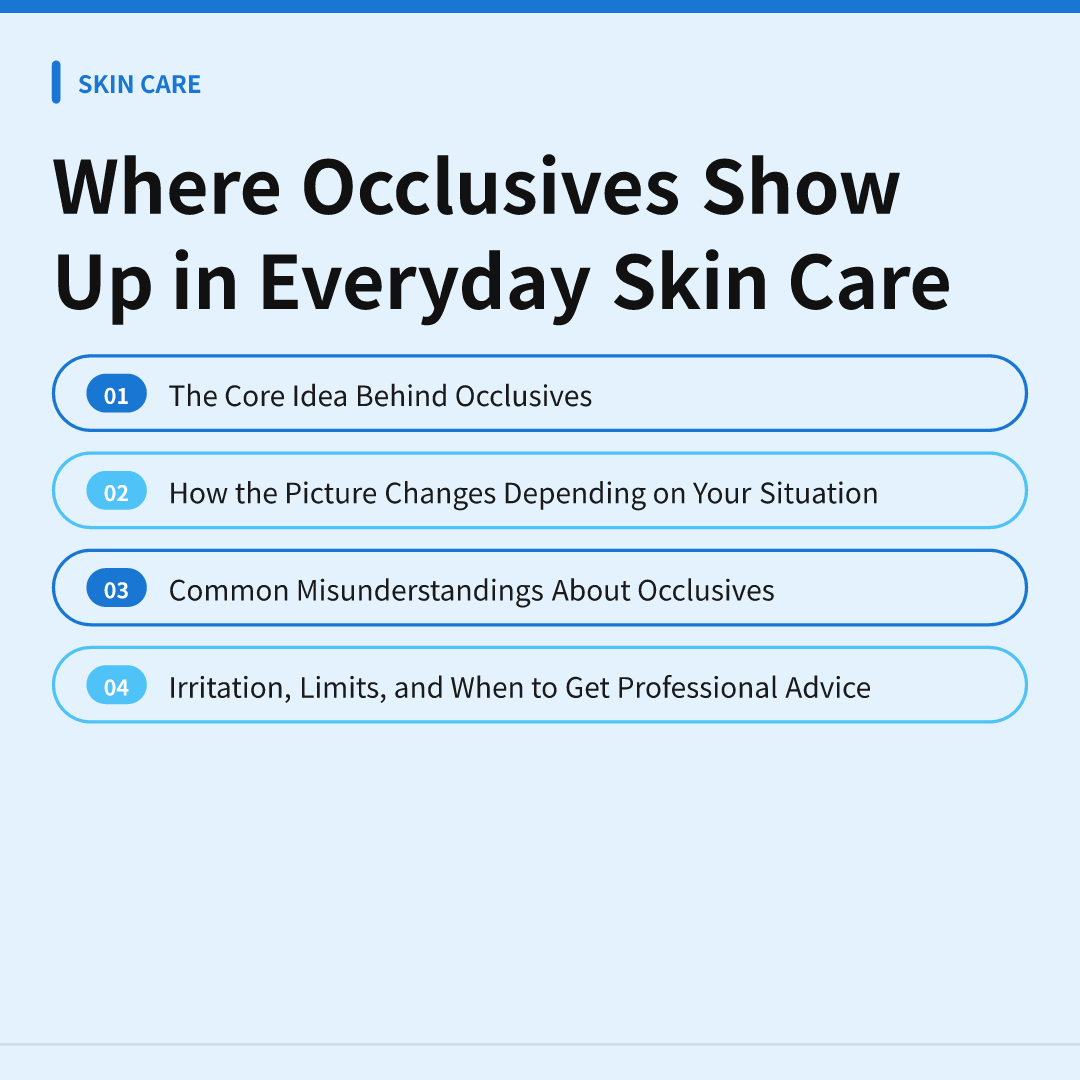
Where Occlusives Show Up in Everyday Skin Care
Occlusives are not a niche ingredient. They appear in thick balms, everyday face creams, lip products, hand creams, diaper-area ointments, and many "barrier" formulas. Even lightweight lotions often contain a small amount of one to help the texture glide and to support the product's overall moisturizing effect.
To make this more concrete, consider two ordinary, hypothetical situations.
Situation one: dry hands in cold, windy weather
Imagine someone whose hands feel tight and rough every winter, especially after frequent washing. Water on the skin evaporates quickly in cold, dry air, and washing can strip away some of the skin's natural oils. A hand cream with an occlusive ingredient is often chosen in this situation because the surface layer it forms may help reduce further water loss between washes.
Situation two: oily, breakout-prone skin that still feels dehydrated
Now picture someone who tends toward shine and occasional breakouts but notices their face feels tight after cleansing. They might worry that any moisturizer will feel heavy. This is where formulation and ingredient choice matter, since some occlusives feel light and others feel rich, and individual skin responds differently. Keeping these two people in mind makes the rest of the explanation easier to follow.
The Core Idea Behind Occlusives

Skin naturally loses a small amount of water to the air throughout the day. According to the American Academy of Dermatology's general skin care guidance, moisturizers are commonly described as products that help skin retain moisture, and they often combine several types of ingredients to do so. Occlusives are one of those types.
Occlusives, humectants, and emollients in plain terms
It helps to see how the three main moisturizer building blocks differ, since they are often mentioned together.
- Occlusives sit on the surface and help limit water evaporation. Common examples include petrolatum, mineral oil, dimethicone, lanolin, and some waxes and butters.
- Humectants attract water. Glycerin and hyaluronic acid are familiar examples.
- Emollients help smooth and soften the skin's surface, often by filling in gaps between skin cells. Many plant oils and fatty alcohols fit here.
Many ingredients blur these lines. Shea butter, for example, is often described as both an emollient and an occlusive, so the categories are better thought of as helpful shorthand than strict boxes.
How the "sealing" effect is usually described
When water-attracting ingredients are paired with an occlusive, the general idea is that the humectant draws in or holds moisture while the occlusive helps keep it from escaping. This is why many moisturizers combine several ingredient types rather than relying on just one. The result is a product that tends to feel more comfortable on dry or tight skin, though the experience differs from person to person.
The National Institutes of Health and other public health resources also describe the skin's outer layer as a barrier that helps hold water in and keep irritants out. Occlusives are often discussed as a way to support that barrier temporarily, particularly when it feels dry or stressed. They do not repair skin in a permanent sense; they help create conditions in which skin may feel more comfortable while it does its own work.
How the Picture Changes Depending on Your Situation
The same ingredient can feel very different depending on skin type, season, and where on the body it is used. That is why advice that works for one person can disappoint another.
Dry and mature skin
Skin that runs dry often feels more comfortable with richer textures that contain a noticeable amount of occlusive ingredients. People with this skin type commonly prefer creams and balms over thin lotions, particularly in colder months. As skin tends to produce less oil with age, richer formulas are a frequent preference, although individual needs vary.
Oily, combination, or breakout-prone skin
People with oily or acne-prone skin often look for lighter formulas labeled non-comedogenic, which means the product is formulated to be less likely to clog pores. Even so, that label is a marketing term rather than a guarantee, and reactions vary. Some people with oily skin find lightweight silicone-based occlusives like dimethicone comfortable, while others prefer to skip heavier products on the face altogether.
Sensitive skin and eczema-prone skin
For people whose skin is easily irritated, simple formulas with fewer added fragrances and botanicals are commonly discussed. The National Eczema Association and the American Academy of Dermatology both describe regular moisturizing as part of general care for dry, eczema-prone skin, and thicker ointment-style products are often mentioned for very dry areas. Because eczema can be a medical condition, a clinician is the right person to advise on what fits an individual case.
Different body areas
- Face: Skin here is more prone to feeling congested with heavy products, so many people choose lighter textures or reserve richer ones for nighttime.
- Hands, feet, elbows, and heels: These areas tend to be drier and thicker-skinned, and richer products are common.
- Lips: Balms with waxes and petrolatum-type ingredients are widely used because lips lack oil glands and can feel dry quickly.
Climate and season
Dry indoor heating, cold wind, and low humidity can make skin feel tighter, and many people naturally gravitate toward richer products during those times. In humid weather, the same product may feel too heavy. Adjusting texture with the seasons is a common habit and not a sign that something is wrong with your skin.
Common Misunderstandings About Occlusives
"Occlusives suffocate the skin"
This idea comes up often, but skin does not breathe through its surface the way lungs do. Occlusives mainly slow water loss; they do not cut off the skin's function. That said, a very heavy product can feel uncomfortable or may not suit someone prone to clogged pores, so comfort and personal tolerance still matter.
"Petrolatum is automatically bad"
Petrolatum is among the most widely used occlusives, and it appears in many products recommended in general dry-skin guidance from dermatology organizations. Concerns sometimes stem from the difference between highly refined cosmetic grades and less refined industrial forms. Product labels and manufacturers can explain what grade is used, and a pharmacist or clinician can address specific worries. As with any ingredient, a small number of people react to it, so individual response varies.
"An occlusive alone is enough to hydrate"
An occlusive helps hold water in, but it does not add much water by itself. If skin is very dehydrated, a product that also contains humectants may feel more balanced. Many people find that applying a moisturizer to slightly damp skin works better with their routine, though exact habits are personal.
"Thicker always means better"
A rich texture is not automatically superior. A heavy balm that suits dry hands may feel greasy on the face, and a product that is too occlusive for oily skin could feel stuffy. The goal is a texture that matches the skin's needs and the person's comfort level.
"More occlusive ingredients can fix any skin problem"
Moisturizers are cosmetic products meant to support comfort and appearance. They are not intended to diagnose or treat skin disease. Persistent redness, scaling, or itching can have causes that a moisturizer will not address, so those symptoms deserve a professional look.
Irritation, Limits, and When to Get Professional Advice
Any skin care ingredient can bother someone. Fragrance, lanolin, and certain preservatives are among the substances that are sometimes associated with skin reactions, and reactions vary widely. According to the U.S. Food and Drug Administration's general cosmetics guidance, consumers who experience a bad reaction to a cosmetic can stop using it and consult a health care provider, and may report the problem through the agency's channels.
Some signs are worth taking seriously rather than waiting out:
- Burning, swelling, or a rash that appears after trying a new product
- Skin that stays very dry, cracked, or itchy despite regular moisturizing
- Oozing, crusting, or signs of infection
- Persistent or worsening breakouts
- Any skin change that is new, unusual, or concerning to you
A dermatologist, primary care clinician, or pharmacist can help sort out whether the issue is dryness, an allergy, a flare of a skin condition, or something else. If a product was recommended for a diagnosed condition, follow the guidance of your clinician and the product's own directions instead of general advice found online. For babies, young children, and people with chronic skin conditions, it is especially wise to check with a professional before changing a routine.
Conclusion: Making Sense of What Occlusives Do in Moisturizers
Understanding what occlusives do in moisturizers makes ingredient lists less mysterious. They are the surface-sealing part of a formula, they work best alongside other ingredient types, and the right amount depends on skin type, season, and body area.
- Occlusives form a thin layer that helps slow water loss from the skin, and they are often paired with humectants and emollients.
- Texture and ingredient choices that suit dry hands may not suit oily facial skin, so personal comfort and reactions guide the decision.
- Persistent irritation, rashes, or ongoing skin concerns are best discussed with a dermatologist, clinician, or pharmacist rather than managed with moisturizer alone.
Disclaimer: This article is for informational purposes only and is not a substitute for professional medical advice, diagnosis, or treatment. Please consult a licensed professional for personal health decisions.
Related reading: Skincare Tips for Men: What They Mean and Why They Matter