Fragrance-Free vs Unscented Skincare: Which One Fits You?
Before asking which is better, it helps to ask what you're actually screening for. The fragrance-free vs unscented skincare debate isn't really a contest between two products — it's a question of criteria. Once you know what you're trying to avoid, whether that's a documented allergy, a compromised barrier, or simply a preference for a scent-free bathroom shelf, the right label tends to sort itself out.
Plenty of people treat the two terms as interchangeable, reach for whichever bottle is on sale, and then wonder why their skin still flares up. That mix-up is common enough that it's worth slowing down and figuring out your own decision criteria before comparing products side by side.
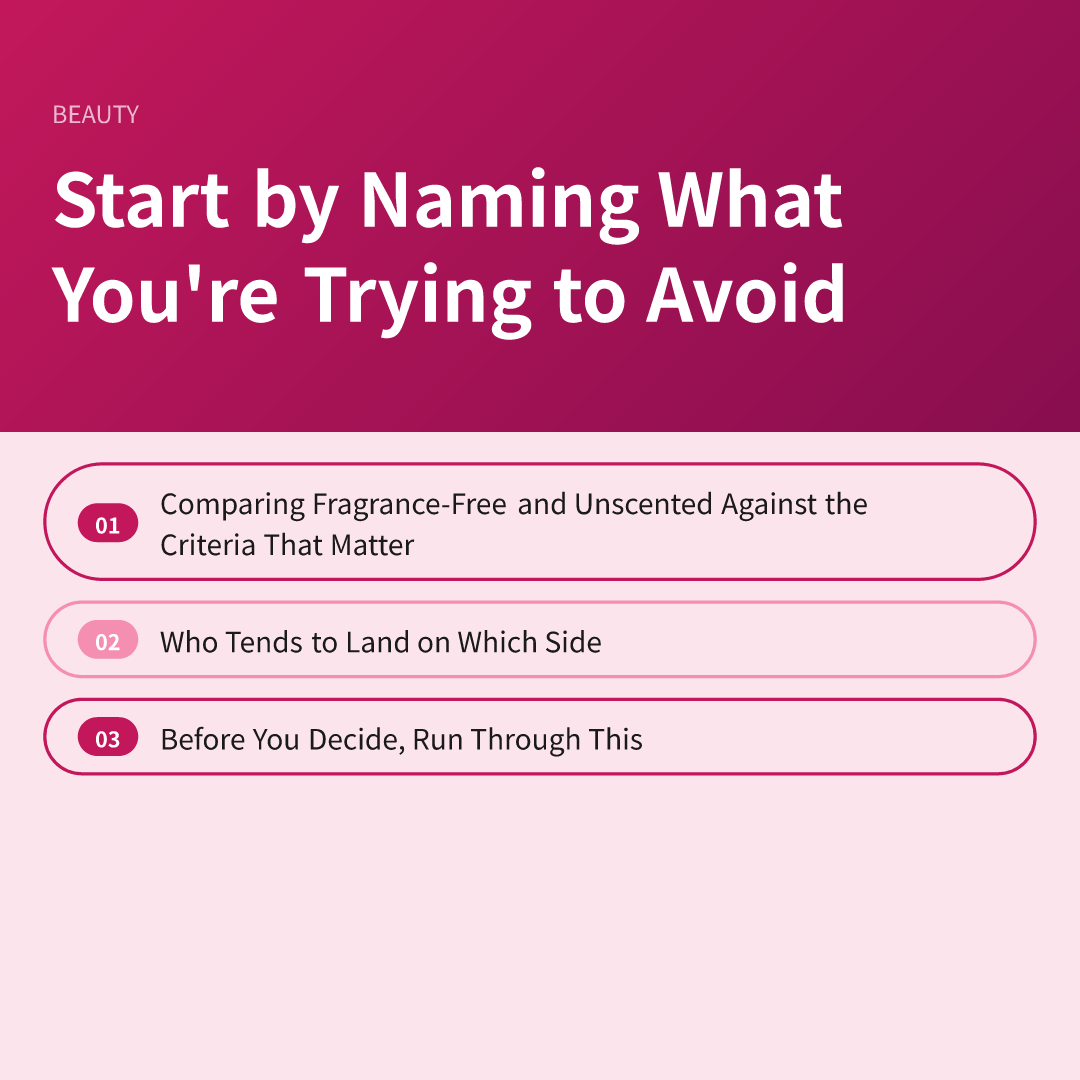
Start by Naming What You're Trying to Avoid
Before comparing labels, it helps to get specific about the actual problem. "I don't want scented products" is too broad to guide a real decision. A more useful starting point is asking: am I avoiding fragrance because of a documented reaction, or because I simply dislike strong smells?
Those are different problems with different solutions. Fragrance-free generally means no fragrance ingredients or masking scents were added at all. Unscented often means fragrance ingredients were used specifically to cancel out the smell of other raw materials, even though the finished product doesn't smell perfumed. If your criterion is "no detectable smell," either might work. If your criterion is "no fragrance chemicals in contact with my skin," only one of them reliably delivers that.
Regulatory labeling rules add another wrinkle. According to the U.S. Food and Drug Administration's guidance on cosmetic labeling, manufacturers aren't required to list individual fragrance ingredients the way they list other components. That means your decision criteria should probably include "am I willing to read the full ingredient list" rather than trusting the front-of-bottle claim alone.
Comparing Fragrance-Free and Unscented Against the Criteria That Matter
Once you know what you're screening for, it's easier to compare the two options criterion by criterion instead of trying to declare an overall winner.
Risk of triggering a reaction
Fragrance-free formulas skip added fragrance compounds entirely, which generally lowers the risk of the specific irritant load fragrance chemicals can introduce. Unscented formulas may still contain masking fragrance ingredients that aren't detectable by smell but are chemically present, which means the reaction risk isn't necessarily lower just because the product doesn't smell like anything.
Suitability for compromised or recovering skin
For skin that's actively healing — after a flare-up, a procedure, or while managing a barrier issue — fragrance-free is usually the more cautious pick, since it removes one entire category of potential irritant. Unscented products can still be fine for recovering skin if the person has no fragrance sensitivity, but it's a less predictable fit when the skin is already reactive.
How much label-reading it demands
Neither label lets you off the hook for checking ingredients. Fragrance-free products still need a scan for other irritants like certain preservatives or actives. Unscented products require an extra layer of scrutiny, since terms like "parfum" or specific botanical extract names can appear in the ingredient list even when the product is marketed as scent-free.
Long-term consistency
Both categories are vulnerable to quiet reformulations — a brand can change a formula while keeping the same packaging and name. Neither label guarantees that what worked for you six months ago is identical to what's on the shelf now, so ongoing label checks are a shared maintenance cost regardless of which option you pick.
Neither label is inherently superior — the right pick depends on why you're avoiding scent in the first place, not just whether the product smells like anything.
Who Tends to Land on Which Side

Fragrance-free tends to be the steadier choice if:
- You have a history of contact dermatitis, eczema, or rosacea-prone skin.
- A patch test has come back positive for fragrance mix allergens.
- You're applying products near the eyes, on broken skin, or after an in-office procedure.
Unscented can be a reasonable fit if:
- Your main concern is personal preference rather than a documented sensitivity — you don't want your moisturizer competing with your perfume.
- You share a bathroom with someone who reacts to strong smells (migraines, for example) rather than someone with a skin allergy.
- You have no known fragrance allergy and simply want a low-scent sensory experience.
One caveat worth repeating: if you have a known or suspected fragrance allergy, unscented isn't an automatic substitute for fragrance-free, since the masking ingredients are still technically present. In that specific case, fragrance-free is generally the more cautious route, and having a pharmacist or dermatologist review the full ingredient list is a reasonable extra step. On the flip side, fragrance-free doesn't guarantee zero irritation either — preservatives, essential oil derivatives used for non-scent purposes, and actives like retinoids or acids can still cause reactions regardless of fragrance status.
It's also worth noting that "natural" or "essential oil–based" labeling isn't a stand-in for either category. Some products marketed as natural or clean beauty still rely on essential oils for scent, and essential oils are a common source of fragrance-related skin reactions. A product can skip synthetic fragrance entirely and still cause irritation through plant-derived scent compounds.
Related reading: Skincare Routine Basics for Oily Skin You Can Keep Up
Before You Decide, Run Through This
If you're switching from one category to the other — or trying either for the first time — a few practical checks tend to prevent avoidable frustration:
- Read the full ingredient list, not just the front-of-label claim, and look for "parfum," "fragrance," or specific botanical extract names.
- Confirm whether your concern is a documented allergy or a general preference, since that changes which label actually solves your problem.
- Introduce new products one at a time, spaced a few days or weeks apart, so a reaction can be traced to a specific product.
- Recheck labels periodically on products you already trust, since reformulations can happen without notice.
- Don't assume "natural" or "essential oil–based" means fragrance-free — check ingredients regardless of that marketing language.
- If you have a history of skin reactions, bring your current products and reaction patterns to a dermatologist or pharmacist rather than guessing from the label alone.
⚠️ Disclaimer: This article is for informational purposes only and does not replace professional medical advice.
Disclaimer: This article is for informational purposes only and is not a substitute for professional medical advice, diagnosis, or treatment. Please consult a licensed professional for personal health decisions.