How to Apply Sunscreen to Ears and the Hairline
The most common mistake is rubbing sunscreen over the face and stopping at the cheeks, which leaves the ears and the edge of the hairline almost bare. Those spots are easy to skip because they sit at the border of "face" and "hair," and they tend to get a lot of direct sun. Covering them well mostly comes down to using a bit more product than feels natural, working it into the edges on purpose, and pairing it with simple physical cover such as hats. Here is where routines usually go wrong and what tends to work better.
According to the American Academy of Dermatology's general sun-protection guidance, sunscreen is only one part of sun safety, and shade, protective clothing, and hats matter too. The ears and scalp line are exactly the places where those other tools earn their keep. Skin reactions and sunscreen preferences vary from person to person, so treat the ideas below as general information rather than personal advice.
Common mistakes with ears and the hairline
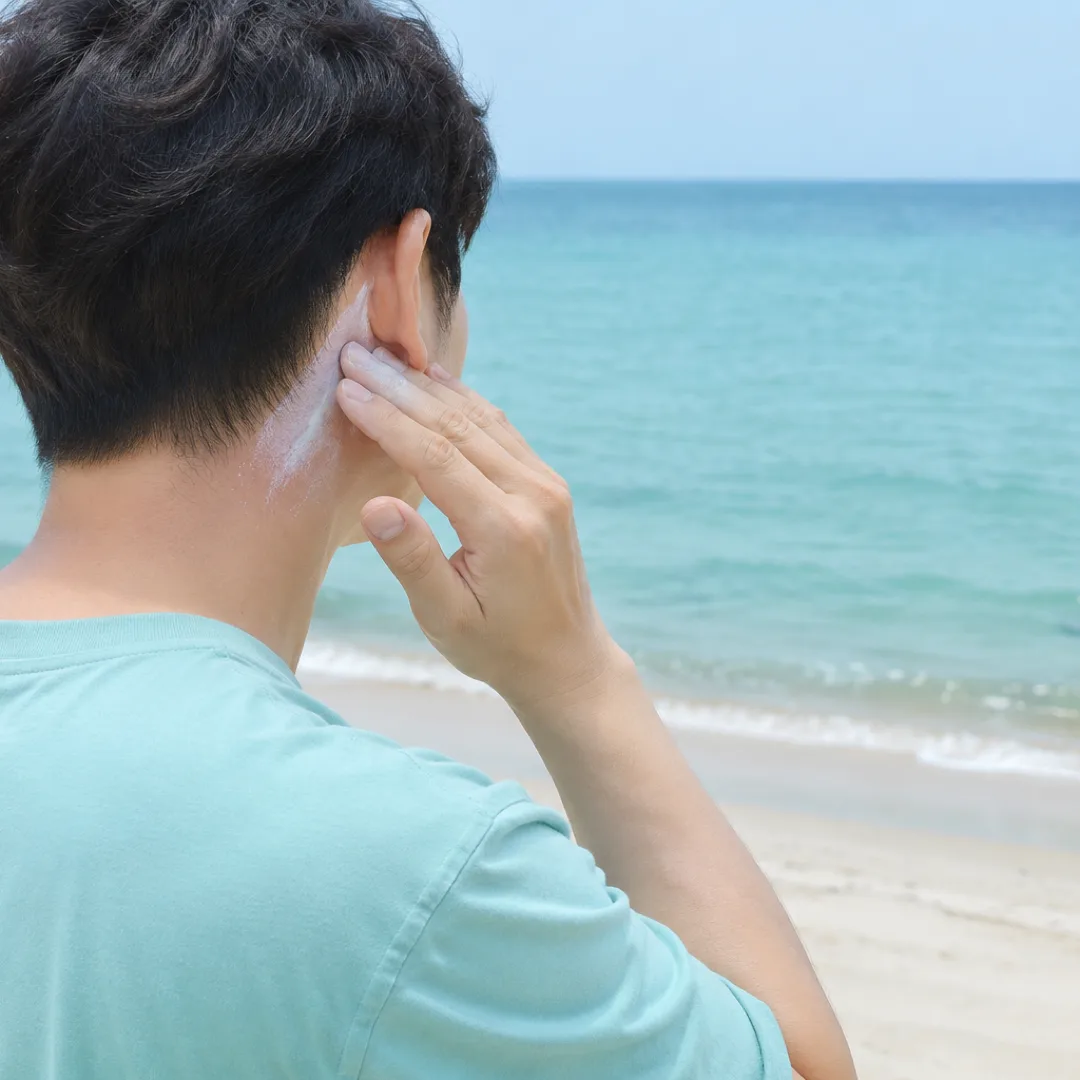
Mistake one: stopping at the face
Many people apply sunscreen in a quick sweep across the forehead, nose, and cheeks and then wash their hands of the job. The reason this backfires is that the ears and the strip of skin just inside the hairline are exposed whenever the sun is overhead or reflecting off water, sand, or pavement. The tops of the ears in particular stick out and catch light from several angles.
A better habit is to treat the ears as part of the face from the start. Run the product over the front, the back, the rim, and the area behind the ear, then move on to the neck. The Skin Cancer Foundation's general guidance also lists the ears among the spots that are often missed, which is a useful reminder to build them into the routine rather than hoping you will remember.
Mistake two: using too little product on small areas
It is tempting to assume a tiny area needs only a tiny dab. The problem is that thin coverage gives uneven protection, and ears have ridges, folds, and curves that hold very little product when it is smeared on lightly. A thin film that looks fine in the mirror may leave gaps you cannot see.
A more reliable approach is to put the product on your fingertips and press it into each fold rather than just wiping across the surface. Read the directions on the label for how much and how often to use your particular product, since recommendations differ between formulas. If you are unsure about amounts, a pharmacist can walk you through the label.
Mistake three: rubbing it in and walking away
Rubbing sunscreen into the hairline until it vanishes looks tidy, but it often moves the product off the exact edge you meant to protect. Hair and sweat then pull more of it away. The result can be a clean-looking face with a visible unprotected margin at the forehead and temples.
Instead, pat or press the product along the very edge of the hair, including the temples and the front of the ears, and then check the line in a mirror. If a small amount of sunscreen touches the hair, that is usually a minor trade-off compared with leaving skin bare.
Mistake four: assuming hair itself is enough
Some people believe a full head of hair covers the part line and the scalp. In reality, hair parts, thins, and moves, so the part line, the temples, and the nape can all be exposed. People with short, thinning, or closely cut hair have even less natural cover.
The practical fix is to consider the part line and any visible scalp as skin that deserves the same attention as the face. Wide-brimmed hats and other head coverings give protection that does not wear off, which is why general public health guidance usually recommends them alongside sunscreen.
Mistake five: skipping reapplication on the edges
Even a careful morning application can fade with sweat, towel drying, and touching your face. Ears and the hairline are high-contact spots because of glasses frames, headphones, hats, and hands pushing hair back. These things can wipe product away without you noticing.
When you reapply, go back to the ears and the hairline deliberately rather than only touching up the nose and cheeks. How often to reapply depends on the product label and on activity such as swimming or heavy sweating, so check the directions that came with your sunscreen.
What to do instead
Pulling the fixes together, a simple routine can make the difference between a patchy finish and even coverage. None of these steps is complicated, and each is meant to remove a specific gap from the list above.
- Pull hair back first. A clip, headband, or loose tie keeps strands out of the way so you can reach the true edge of the hairline.
- Work in sections. Do the forehead edge, each temple, the front of each ear, the rim, and the back of each ear as separate small steps instead of one big swipe.
- Press into folds. Use fingertips to dab product into the curves of the ear rather than gliding over the top.
- Do a mirror check. Look for shiny, even coverage along the hairline and behind the ears, and fill in any dull or bare patches.
- Add physical cover. A wide-brimmed hat that shades the ears and a seat in the shade reduce how much you depend on a thin layer of product.
Choosing a texture that suits these areas
Texture changes how easy it is to cover the edges. Creams are often easy to press into ear folds, while sticks can give more control along the hairline and around the ears. Sprays can be convenient for reaching tricky spots, but it is easy to miss patches, and the label may suggest rubbing the product in afterward. Gel or lightweight lotion formulas may feel more comfortable if you sweat a lot.
Mineral and chemical filters behave differently on skin and hair, and reactions vary from person to person. If a product stings, causes redness, or seems to irritate your skin, it may be worth trying a different formula and asking a pharmacist or healthcare professional for guidance.
Adapting for different situations
Short hair, shaved heads, and thinning hair
With less hair, the part line, scalp, and the tops of the ears are more exposed. The scalp is also easy to forget because you rarely see it. In these cases, treat the entire scalp as skin that needs protection, and consider a hat as the main strategy for long outdoor days, with sunscreen on any area the hat leaves uncovered.
Long hair and styled hair
Long hair can shade the ears at times, but it moves, and a ponytail or bun suddenly exposes both ears and the nape. If your hairstyle changes through the day, protect the skin as though it will be exposed at some point. Applying sunscreen before you style your hair makes it easier to reach the edges, and a check in the mirror afterward can catch gaps.
Glasses, headphones, and masks
Frames and straps rub against the skin around the ears and temples, which can remove product in a thin line. If you wear these items regularly, check those contact points more often. Applying sunscreen first and letting it settle before putting on gear may reduce smearing, though it will not remove it entirely.
Swimming, sports, and sweaty days
Water and sweat wash product off the ears and hairline quickly, and towels make it worse. For these days, read the label to see whether the formula is described as water resistant and what reapplication timing it suggests. Shade, a hat, and a swim cap or rash-style head covering can reduce how much you rely on sunscreen alone.
Sensitive skin and skin conditions
The skin around the ears and hairline can be prone to dryness, flaking, or irritation in some people, and conditions such as eczema or seborrheic dermatitis may affect these areas. Because sunscreen products and ingredients can interact with sensitive skin in different ways, people with ongoing irritation may want to talk with a dermatologist or other qualified professional about what suits them.
When a professional should look at it
The Skin Cancer Foundation and other public health groups generally encourage people to have a professional look at any spot that changes, bleeds, itches, or does not heal. Ears and the scalp are places where such changes are easy to miss because they are hard to see. Regular skin checks with a qualified professional can help catch things you cannot see in the mirror, and the frequency depends on your personal situation.
Frequently asked questions
Do I really need sunscreen on my ears if I wear a hat?
If your hat has a wide brim that shades the ears, it can cover a good deal of the exposure, but sunlight can still reach the ears from the side and from reflected surfaces. A baseball-style cap leaves the ears uncovered, so sunscreen is still worth considering in that case. Many people use both, since the hat can shift or slip during the day.
Will sunscreen on my hairline make my hair greasy or leave a white cast?
It can, depending on the formula and how much touches the hair. If a thick cream leaves residue, a lighter lotion, gel, or stick may be easier to keep along the edge, and mineral formulas may show up more on darker hair. Trying different textures and checking the result in a mirror can help you find something you are comfortable wearing.
Is it a problem if sunscreen gets in my ears or on my scalp?
If product gets on the outer ear or scalp, that is generally what these areas are meant to be covered with, but products meant for the face may feel different on a sweaty scalp. If you notice stinging, redness, itching, or discomfort, it may be a reaction to a particular product. A pharmacist or healthcare professional can help you work out what to try next.
Disclaimer: This article is for informational purposes only and is not a substitute for professional medical advice, diagnosis, or treatment. Please consult a licensed professional for personal health decisions.
Related reading: What PA Ratings Mean on Sunscreen, Explained Simply